Mayo Clinic Applies AI to ECG Screening and Patient Record Review
Mayo’s ECG models detect heart disease using routine tests, while Record Time organizes outside records to reduce physician preparation time.
Mayo Clinic’s AI work shows two practical ways a health system can apply machine learning: read signals already produced during routine care to identify hidden heart disease, and organize patient records so clinicians can prepare for visits faster. The projects address different bottlenecks, but share a useful design principle: fit AI into existing clinical work rather than asking staff or patients to build a new process around it.
The scale behind that work is substantial. Mayo, a nonprofit academic medical center headquartered in Rochester, Minnesota, had nearly 85,000 employees in 2025, with campuses in Arizona and Florida and a regional health system spanning three Upper Midwest states. It reported $473 million in operating income and committed $9 billion to expansion. The organization says more than 200 AI projects are underway, at stages ranging from feasibility studies to clinical deployment. In 2025, it integrated 22 Mayo Clinic Platform solutions into care and closed nearly 200 agreements spanning AI, biopharma and diagnostics.
Since its launch in 2019, the Mayo Clinic Platform has assembled research infrastructure covering more than 15 million patient records, along with billions of radiology images, lab results and clinical notes. Two applications draw on that clinical experience and data: ECG analysis for early disease detection, and Record Time, a system for reviewing outside medical records.
Reading heart disease signals in routine ECGs
Left ventricular dysfunction can weaken the heart’s pumping ability before symptoms appear and can precede heart failure. Detecting it has traditionally required an echocardiogram, which calls for specialized equipment and a trained sonographer. That requirement makes broad screening harder, even as heart failure affects nearly 6.7 million Americans. The figure is projected to reach 8.7 million by 2030; direct U.S. medical spending on the condition was estimated at $32 billion in 2020. Fewer than one in four eligible patients receive recommended therapy, in part because the underlying dysfunction can go undetected until symptoms develop.
Mayo researchers looked to the electrocardiogram, a routine, comparatively inexpensive test that records the heart’s electrical activity. They screened more than 625,000 paired ECG and echocardiogram records from Mayo patients, then trained a neural network on nearly 98,000 pairs. The model learned electrical patterns associated with a weakened heart pump. The approach has since expanded to identify signals associated with atrial fibrillation, cardiac amyloidosis, aortic stenosis, hypertrophic cardiomyopathy and biological age.
The models can analyze standard 12-lead ECGs as well as single-lead readings from smartwatches and a digital stethoscope. For cardiac amyloidosis, a version evaluated across 25,525 patients at four U.S. health systems achieved 78.9% sensitivity and 91.2% specificity. Those results describe that particular evaluation; they don’t establish that every model or use case performs at the same level.
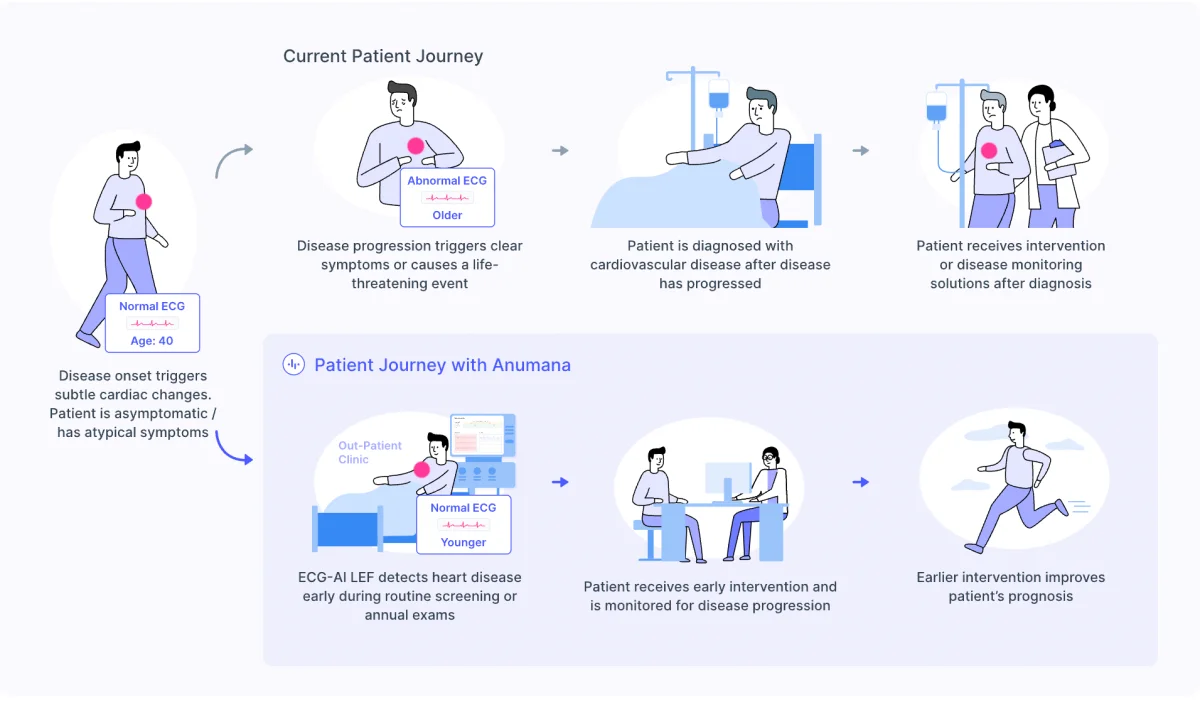
For patients and clinicians, the appeal is that the analysis can use an ECG already collected during a routine visit. A positive result can prompt an echocardiogram or referral that might not otherwise have been considered. A digital stethoscope extends the idea beyond the clinic: in a Nigerian obstetric study, AI-assisted readings flagged twice as many cases of peripartum cardiomyopathy as standard care. That example suggests how a model can reach more patients when it is added to a familiar examination step.
Mayo tested ECG-guided screening prospectively in the EAGLE trial. The study enrolled 22,641 patients across 348 primary care clinicians and 45 medical centers in Minnesota and Wisconsin over eight months. Compared with usual care, AI-guided screening increased diagnoses of low ejection fraction by 32%, or about five additional diagnoses for every 1,000 patients screened. That is evidence of improved detection in the study setting; the reported figure does not by itself show how screening changes long-term outcomes.
The 12-lead algorithm is FDA-cleared and licensed to Anumana, which Mayo co-founded with healthcare data analytics firm nference. Mayo has also worked with Eko Health on a single-lead version for handheld and wearable devices. The cardiac amyloidosis application received FDA clearance in April 2026 and is in an early stage of commercial rollout. Together, prospective study results, clearance and licensing give the ECG work a more developed evidence base than an early feasibility project.
Turning outside records into a usable history
Mayo physicians may receive dozens or hundreds of pages before a visit, often from patients seeking a third or fourth opinion after care at other health systems. Those records can arrive fragmented and unsorted. Dr. Alexander Ryu, an internal medicine physician and vice chair of innovation for Mayo’s Department of Medicine, said Mayo receives tens of millions of pages each year. Finding the details that matter across that volume takes time and can make preparation harder.
Record Time, developed with Scale AI using the Scale Generative AI Platform, ingests external records, puts them in chronological order and produces concise summaries. Clinicians can also search the material. The collaboration has a broader scope: Scale says it includes work to detect safety events, such as wrong-site surgeries or falls, within routine reporting, and to reduce staff administrative work. Data used in the collaboration stays within Mayo’s HIPAA-compliant environment.
The reported time savings vary by account. Scale AI says physicians have gained an average of 11 more minutes with each patient since the tools launched. Ryu described saving five to 30 minutes of preparation per visit, depending on case complexity. He also said the tool helps surface details buried in a record that could affect decisions about treatment or testing. These are measures of time and workflow, rather than evidence that the tool improves clinical outcomes.
Record Time is in use, and Mayo has roughly 150 AI models running across its system. Its practical value will depend on whether summaries and search results reliably help clinicians find relevant history across varied records. The broader lesson from both applications is that AI’s contribution can be measurable when it targets a defined task: detect a risk from a test already being collected, or make a large record easier to review. The next question is how consistently those gains hold across patients, care settings and the decisions clinicians make.
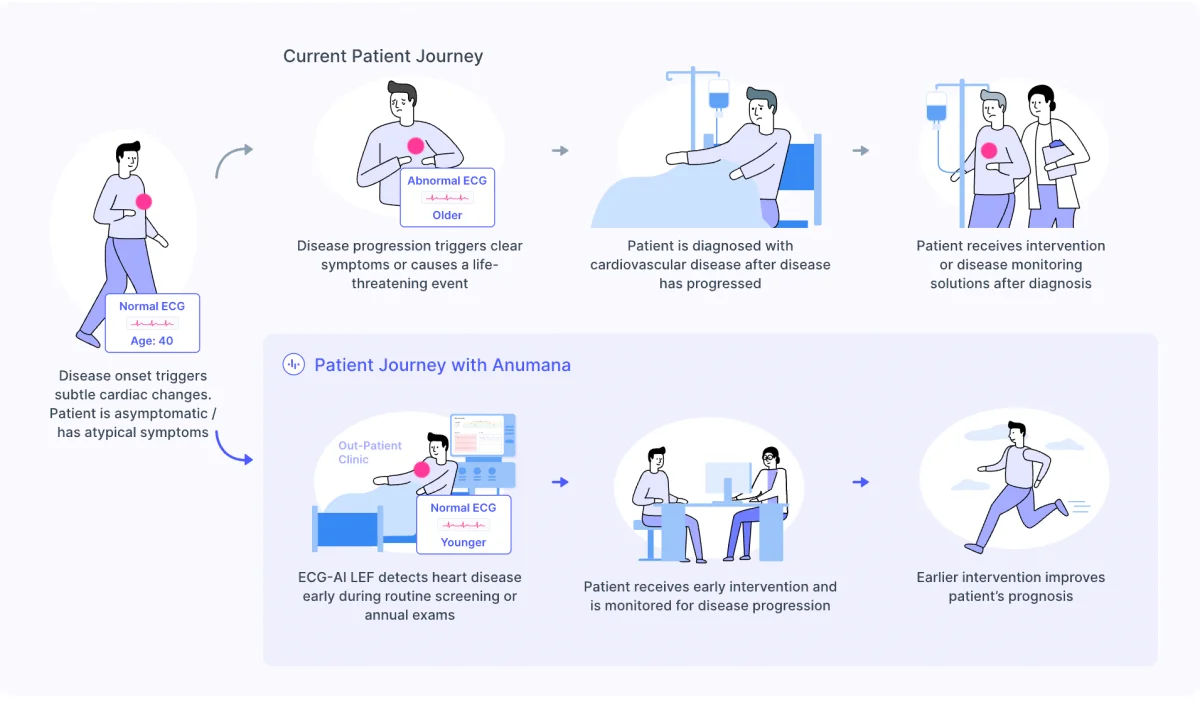
Illustration of Anumana’s ECG-AI LEF model. Source: Cardiovascular.com


