Cleveland Clinic Scales Ambient AI Scribes and Sepsis Alerts Across Its Health System
Cleveland Clinic reports faster documentation and fewer sepsis alerts, while key outcomes remain self-reported and local deployment details are limited.
Cleveland Clinic’s AI program is moving into routine clinical work at a large health system scale. Two deployments show where it sees near-term value: drafting visit notes so clinicians spend less time charting, and identifying patients at risk of sepsis while reducing alert noise. The early results are notable, but they don’t yet establish financial returns or improved patient outcomes at Cleveland Clinic.
The nonprofit academic medical center, headquartered in Cleveland, operates in Florida, Las Vegas, Toronto, London, and Abu Dhabi. It reports 83,000 caregivers, 23 hospitals, and 300 outpatient facilities. In 2025, it recorded 15.9 million patient encounters, including 14.4 million outpatient encounters, and $18.3 billion in operating revenue. At that scale, even modest workflow changes can affect many clinicians and visits.
Leadership has made AI an enterprise priority. Cleveland Clinic appointed its first Chief AI Officer in 2024 to lead strategy, safety, and governance. In a 2026 State of the Clinic address, CEO Dr. Tom Mihaljevic pointed to staffing, scheduling, supply chain, clinical risk prediction, and paperwork automation as areas where AI could support caregivers. The organization hasn’t disclosed a total AI investment figure. Its public commitments include a Virtual Command Center for hospital operations, developed with Palantir Technologies and announced in 2023, alongside the clinical deployments described here.
Ambient documentation: reducing time in the chart
Ambient documentation tools listen to a patient visit, with consent, and draft a clinical note for the clinician to review. Cleveland Clinic’s platform uses a phone app to capture the conversation and create a structured note inside Epic, its electronic health record system. The platform also offers documentation integrity support, point-of-care coding, and customized after-visit summaries.
The operational case is clear: documentation can spill into evenings and compete with time spent with patients. In the American Medical Association’s 2025 survey of nearly 19,000 physicians, 41.9% reported at least one symptom of burnout; ineffective electronic health record systems and administrative work were among the leading stressors. Its 2024 data found that 22.5% of physicians spent more than eight hours a week on the record system outside normal working hours. For a health system with 14.4 million outpatient encounters in a year, small savings per visit could add up. Whether they do depends on adoption and the extra review work the draft requires.
Cleveland Clinic’s selection process reflected its broader approach to AI: partner where possible, build only when necessary. Chief Digital Officer Rohit Chandra has described vendor selection as closer to buying into a company than buying a finished product, since many AI offerings are still developing. His team favors trials with clear outcomes over traditional requests for proposals, and he has identified change management as a harder challenge than the technology itself.
During 2024, Cleveland Clinic compared five ambient scribe products, scoring documentation quality, features, clinician satisfaction, ease of implementation, and return on investment. Accounts of the evaluation differ in scope. The American Hospital Association describes 25 to 35 clinicians per vendor and trials lasting three to five months. Cleveland Clinic’s Consult QD account describes approximately 250 physicians across more than 80 specialties and subspecialties. Fierce Healthcare reports more than 300 clinicians over six months. The accounts agree that five vendors were tested, but don’t provide one consistent description of the evaluation’s size and duration.
Healthcare IT Today’s video on Cleveland Clinic’s scribe evaluation
Cleveland Clinic selected Ambience Healthcare and awarded it a five-year exclusive partnership. Fierce Healthcare reported that providers later logged 25,000 encounters with Ambience across 20 specialty areas. Neither Cleveland Clinic nor Ambience has disclosed the language model behind the product. That leaves an important technical question unanswered for organizations assessing how the system generates notes and how its performance might change as underlying components evolve.
Adoption varied across specialties, which makes the aggregate result harder to interpret on its own. During the evaluation, Ambience reached 80% adoption among participating clinicians. Cleveland Clinic’s Beth Meese described that as two to three times the adoption of the other four products, based on anecdotal comparisons; the health system hasn’t published the competing products’ results. Reported adoption ranged from 99% in nephrology to 55% in urology. In cardiology, it rose from 50% to 71% after feature refinements. Meese cited documentation quality and the vendor’s responsiveness to clinician feedback as factors in the choice.
The deployment was staged according to workflow complexity. A peer-reviewed account in npj Health Systems describes four waves: clinicians moving from other scribe tools, followed by about 80% of target users with an emphasis on primary care, then selected specialties making up the next 10%, and finally complex specialties where the model was still being optimized. Training was required before access. The program included live virtual sessions three times a day and physician super-users at training.
Patients receive advance notice and can opt out, while use is voluntary for ambulatory providers. During a visit, the app captures the conversation as the clinician speaks with the patient. Afterward, the clinician reviews and edits the draft before it enters the record, and the patient receives an after-visit summary. That review step matters: a generated note still needs clinical judgment before it becomes part of a medical record.
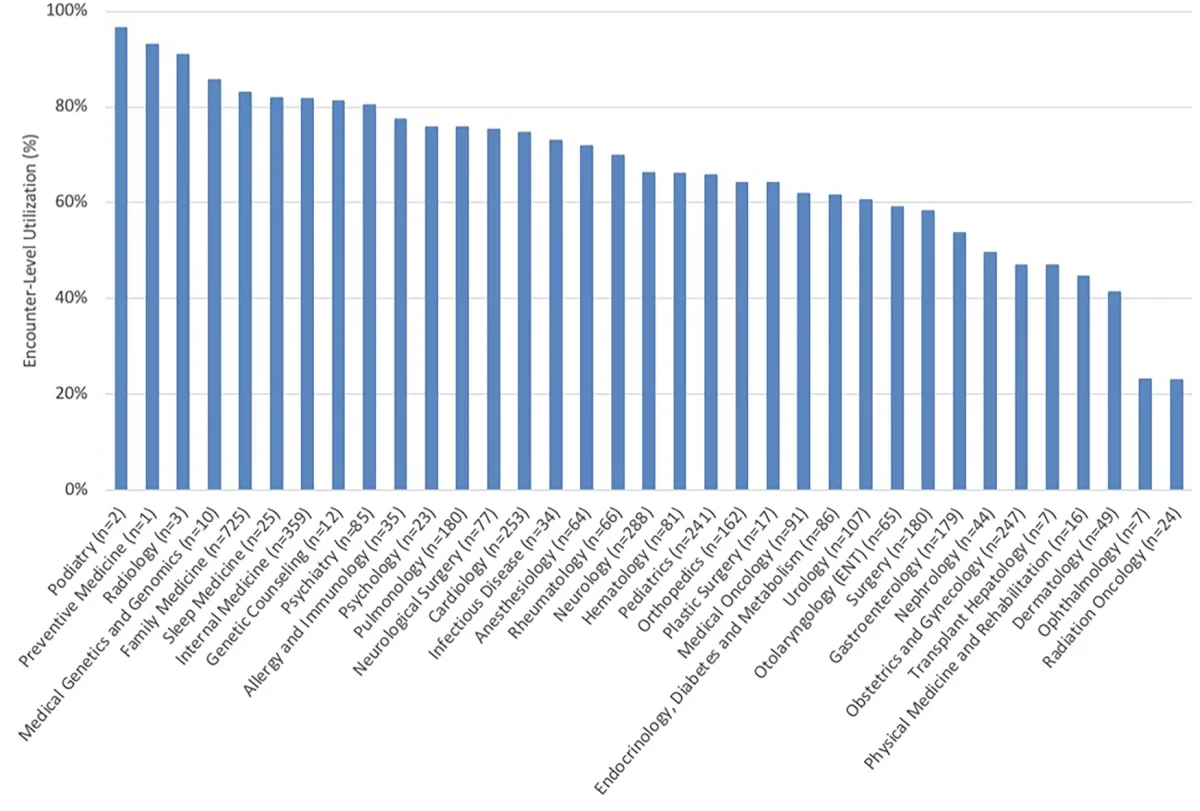
Enterprise rollout began March 10, 2025, and reached more than 4,000 clinicians in about four months. Roughly a year after deployment, the npj Health Systems paper reported more than 4,800 clinicians using the tool across over 3.5 million encounters. Established users had 70% encounter-level utilization. The paper also reported a Net Promoter Score of 60, a satisfaction score of 96.6%, and that 60% of users agreed the tool increased their likelihood of remaining in practice. Half the paper’s authors work for Ambience and disclosed equity in the company; the retention figure captures stated intent, not observed turnover.
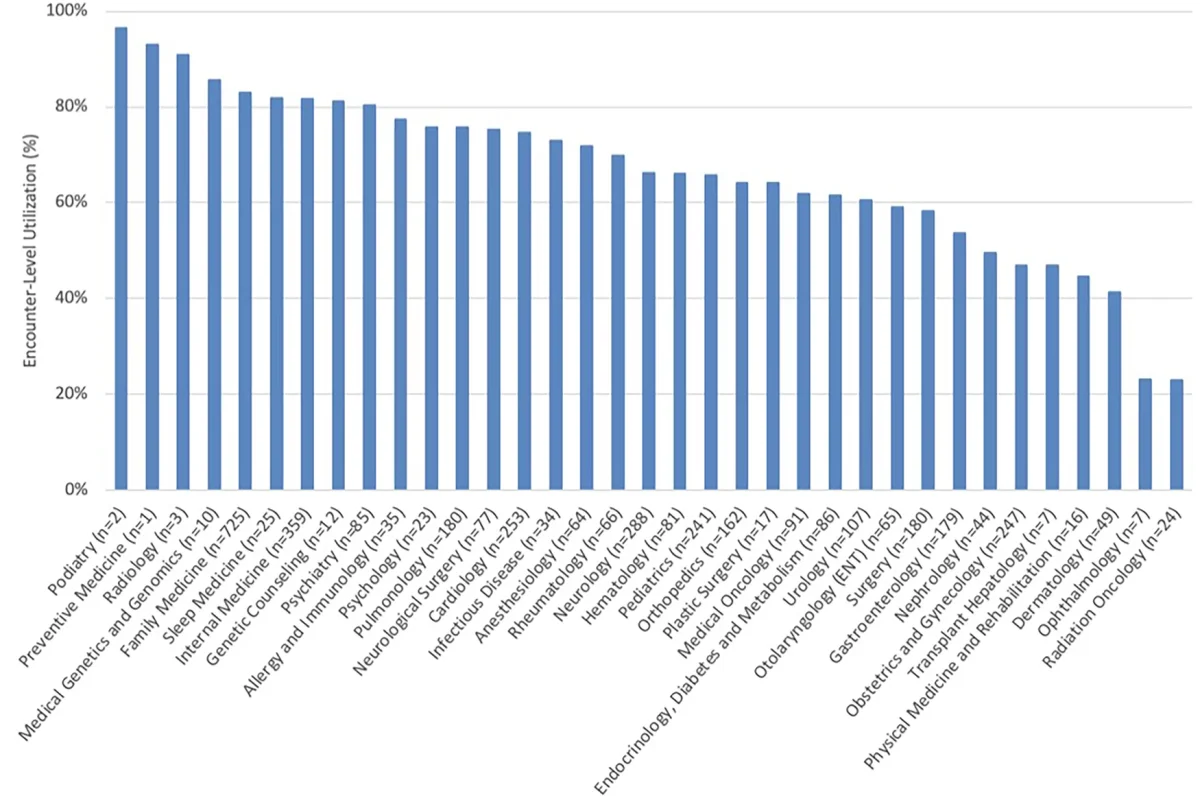
AI scribe encounter-level utilization by specialty, 12 months after deployment. Source: npj Health Systems.
Cleveland Clinic’s own accounts add estimates of time saved: roughly two minutes per appointment and 14 minutes per clinician per day. Active users relied on the tool for 76% of scheduled visits. Fierce Healthcare reported trial-stage results of a 49.6% reduction in after-hours documentation time, a 25% reduction in note creation time, a 32% increase in time with patients, and reduced cognitive burden for 67% of clinicians. These measures are self-reported and haven’t been independently audited. Cleveland Clinic hasn’t published a financial return for the program.
Sepsis detection: fewer alerts, earlier identification
The second deployment focuses on a different clinical problem: finding sepsis early enough for teams to act without overwhelming them with warnings. The Association of American Medical Colleges estimates that sepsis accounts for about $62 billion a year in hospital and skilled nursing care in the United States. The Centers for Disease Control and Prevention estimates that about 1.7 million adults develop sepsis each year and at least 350,000 die during hospitalization or are discharged to hospice. The AAMC says each hour of treatment delay raises the risk of death by 4% to 9%.
Earlier warning systems can fail in opposite ways: missing patients who develop sepsis, or generating so many alerts that clinicians have trouble distinguishing useful signals. A 2021 JAMA Internal Medicine evaluation of a widely used proprietary model at Michigan Medicine found it missed 67% of sepsis patients while alerting on 18% of all hospitalized patients. Cleveland Clinic hasn’t named the legacy tool it replaced. In its own comparison, it said the legacy tools produced roughly ten times as many false alerts as the AI platform it adopted.
Bayesian Health’s platform continuously analyzes electronic record data, including lab results, vital signs, and clinical notes, to assess each patient’s sepsis risk. The vendor describes this as an ongoing review of the patient record, rather than episodic screening based on fixed rules. Cleveland Clinic says the system integrates sepsis insights into existing clinical workflows so care teams can prioritize patients at risk. James Morrison, MD, chairs the health system’s Enterprise Sepsis Steering Committee, which oversees the integration of detection tools into care.
The technology builds on the Targeted Real-time Early Warning System, or TREWS, a machine learning model studied across five hospitals and 590,736 monitored patients. A 2022 Nature Medicine paper reported that, when clinicians confirmed an alert within three hours, in-hospital mortality fell by 3.3 percentage points, an 18.7% relative reduction. Among higher-risk patients, the absolute reduction was 4.5 percentage points.
Bayesian announced that its platform received FDA 510(k) clearance in May 2026. The vendor also cited 82% sensitivity, 89% provider adoption, and detection 5.7 hours earlier than standard care. Those figures come from its research program; they aren’t results from Cleveland Clinic’s deployment.
WKYC video on Cleveland Clinic’s expanded use of sepsis detection technology
The Cleveland Clinic pilot at Fairview Hospital covered more than 3,330 patients in 2024 and 2025. The health system reported a tenfold decrease in false alerts, a 46% increase in identified sepsis cases, and a sevenfold increase in cases flagged before antibiotics were given. These are results from a single-hospital evaluation, reported by Cleveland Clinic and not published in a peer-reviewed journal. The system hasn’t disclosed mortality, length-of-stay, or cost outcomes from its own deployment.
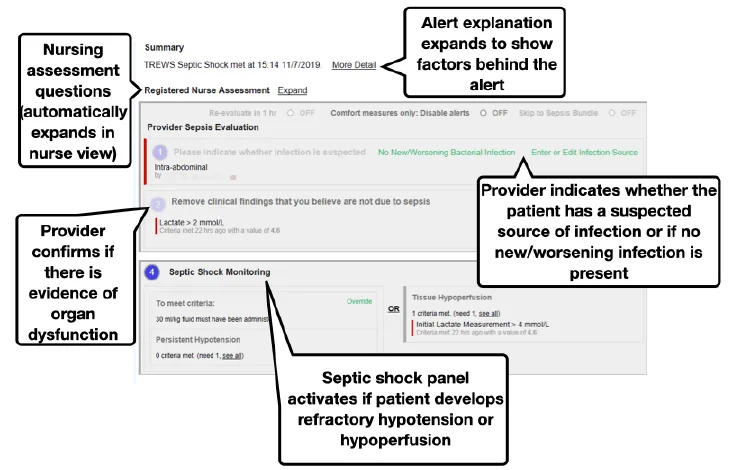
Annotated TREWS research interface showing nurse assessment, clinician evaluation, and septic shock monitoring panels. Source: npj Digital Medicine.
One practical limitation remains: Cleveland Clinic hasn’t published who receives alerts, how clinicians confirm them, or how the system routes warnings between nurses and physicians. Those details matter because the TREWS study linked its reported mortality benefit to clinician confirmation within three hours. For care teams considering similar tools, the useful measures include false-alert rates and time from alert to action, alongside sensitivity and the number of cases found. Detection performance alone doesn’t show whether a tool fits the clinical workflow.
Cleveland Clinic reports that the Bayesian platform is in place at 13 hospitals, with expansion planned across Ohio and Florida; HealthLeaders describes the 13 hospitals as testing the technology. The organizations also plan to develop AI modules for other critical conditions. That points to a broader program, but the sepsis deployment’s patient outcomes and operating costs remain undisclosed.
What the deployments show
Across both use cases, Cleveland Clinic’s approach emphasizes testing, workflow fit, and staged adoption. The scribe evaluation compared five products against defined criteria before a multiyear commitment. Its rollout moved from more familiar workflows toward specialties requiring further optimization. In sepsis detection, the reported reduction in false alerts is as central to the case as the rise in identified cases: a warning system has to earn clinicians’ attention to influence care.
For now, the strongest evidence is operational. The scribe has reached thousands of clinicians and millions of encounters, with reported usage and satisfaction measures. The sepsis pilot found fewer false alerts and more cases identified before antibiotics. Neither set of Cleveland Clinic results yet establishes improved patient outcomes or a financial return. Those are the measures to watch as deployments expand and the organizations publish more detail.


