Character.ai Details PipSqueak 2, Memory Upgrades and Lorebook
PipSqueak 2 brings stronger character consistency and recall; Memory changes are arriving now, with Lorebook planned for a later release.

Character.ai’s April update focuses on three parts of the chat experience: a replacement for its PipSqueak model, changes to how Memory records and surfaces details, and a forthcoming Lorebook feature for character creators. The practical goal is to make long conversations and persistent fictional settings easier to maintain without repeatedly restating context.
The company also acknowledges that recent changes have frustrated users. It says expanded age restrictions, usage limits on some features, and more ad placements for free users arrived close together. Character.ai says those changes help it keep the service free and available to a broad audience. It describes itself as a small team serving millions of users each month, without outside investors, and says operating AI at that scale while maintaining safety standards worldwide carries substantial costs.
PipSqueak 2 targets consistency and recall
The main model release is PipSqueak 2, or PSQ2, which will replace the current PipSqueak. c.ai+ members get access first, starting today, while the rollout to free users is scheduled for early May. Character.ai says the model is improved in three areas: staying in character, retaining details from earlier in a conversation, and producing more varied, expressive writing.
Those changes address familiar problems in extended character chats. A character may gradually lose its established voice or details, leaving the user to correct it or repeat information. PSQ2 is intended to reduce that drift and keep previously established context available for later replies. The company also says it expects fewer repetitive passages and conversational loops, with more natural dialogue and sharper descriptions.
Character.ai reports that users in its testing consistently preferred PSQ2 to the existing PipSqueak. It doesn’t provide benchmark scores, test group size, or a measurement of how much the model improves on each dimension. The reported preference is therefore a user evaluation, not a quantified performance comparison. The rollout will show whether the gains hold across different characters and conversation styles.
DeepSqueak, which the company describes as its most powerful model, is also being updated over the coming weeks. The changes are meant to improve uptime and chat quality and reduce gibberish and responses that stop midstream. These reliability improvements are planned for c.ai+ members. Character.ai says DeepSqueak 2 is training, with early results looking promising, but gives no release date or technical details.
Memory changes make stored details easier to see
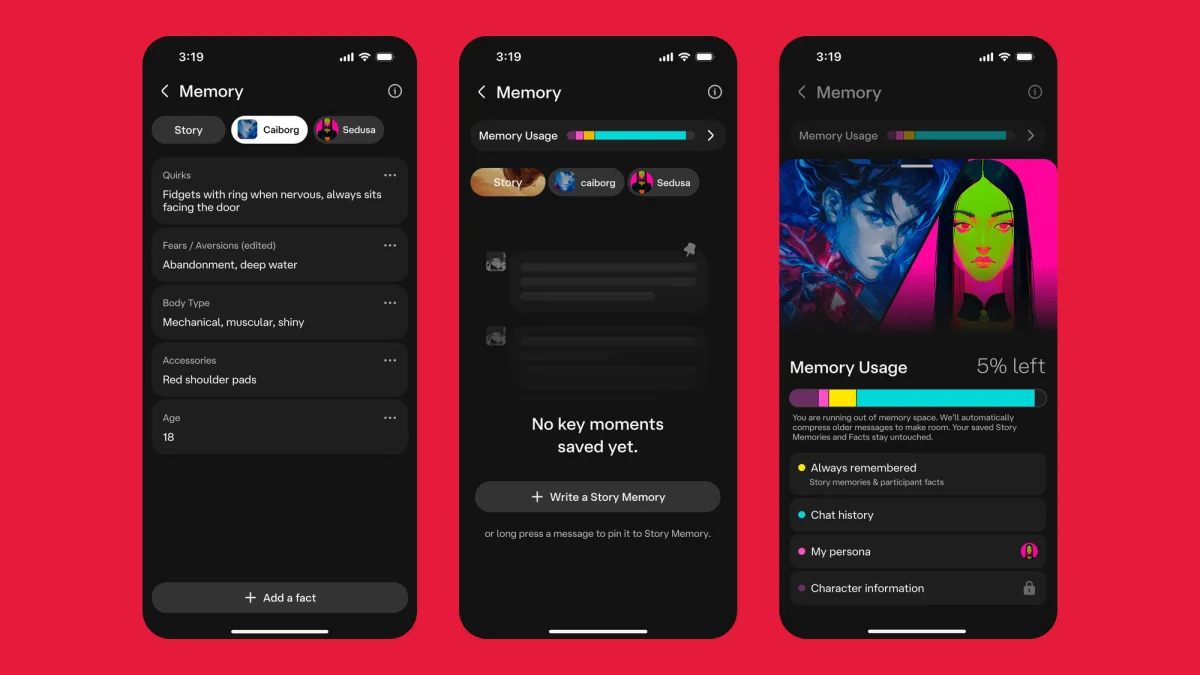
Some Memory updates are already live. The in-app Memory page has a refreshed layout, and the system can track more categories of information, including hairstyle, eye color, and quirks. Character.ai says these details are meant to help keep both Characters and Personas consistent. A new in-chat notification appears when a memory is recorded, giving users a clearer signal about what the system has retained.
That visibility matters because a system can only help with continuity when users have some sense of what it has stored. The update makes memory capture easier to notice, while the expanded categories give the feature more specific details to work with. The announcement doesn’t explain how users can inspect, edit, or remove each newly recorded detail, so the refreshed page and notification are the concrete controls described so far.
Memory Visualization is planned next for c.ai+ members. It will show how much memory remains in a conversation before the system begins forgetting information or compressing details. Character.ai says the meter should make the limit easier to anticipate, though it hasn’t shared how that capacity is measured or what happens when it runs low.
The team is also developing a “Remember this” action to improve on the current pin feature, along with changes to memory compression. The stated aim is to keep important details from getting lost in long chats. Both features are still in development, and the company says it will share more as they roll out over the coming weeks.
Lorebook gives creators a way to define a character’s world
Lorebook is the largest feature still to come. It’s designed for creators who want a Character to draw on a defined world: its history, places, rules, and the background of people in it. Creators will be able to make lore entries and attach them to particular Characters. When a conversation touches on relevant material, the system is intended to surface the appropriate entry, carrying that knowledge across chats.
In practice, this could help with settings that depend on many connected facts. A creator might establish details about a fictional location or a character’s past once, then have those details available in later conversations. The feature is aimed at reducing repeated setup and helping Characters stay consistent with the world their creators have built. Character.ai says it has tested Lorebook with members of its Creator community and describes the results as impressive, but provides no measurements or examples of those tests.
This will be Lorebook’s first version, and Character.ai says it plans to continue developing the feature. Access is expected to begin with c.ai+ members, followed by broader availability in the coming months. The rollout should clarify how creators organize entries and how reliably the system selects relevant material during a chat.
What to watch in the rollout
The next two months are expected to bring more releases, though the company hasn’t provided a detailed schedule. The immediate changes to track are PSQ2’s arrival for free users in early May and the initial Memory updates already available in the app. Later, Memory Visualization and “Remember this” should show how much control users get over long-term context, while Lorebook will test whether creator-defined knowledge can stay useful across separate conversations.
For now, Character.ai’s claims rest on community testing and the described behavior of each feature, rather than published benchmarks. Users can try PSQ2 as access expands and open the updated Memory page through the notebook icon. Their experience with consistency, recall, and long-chat detail retention will be a practical measure of whether these changes solve the problems they target.


