Mori Is a $649 Mushroom Robot Lamp Built for Ambient Companionship
OKA’s camera-equipped lamp reacts to people, plays nature sounds and guides breathing exercises, with subscriptions required for some features.
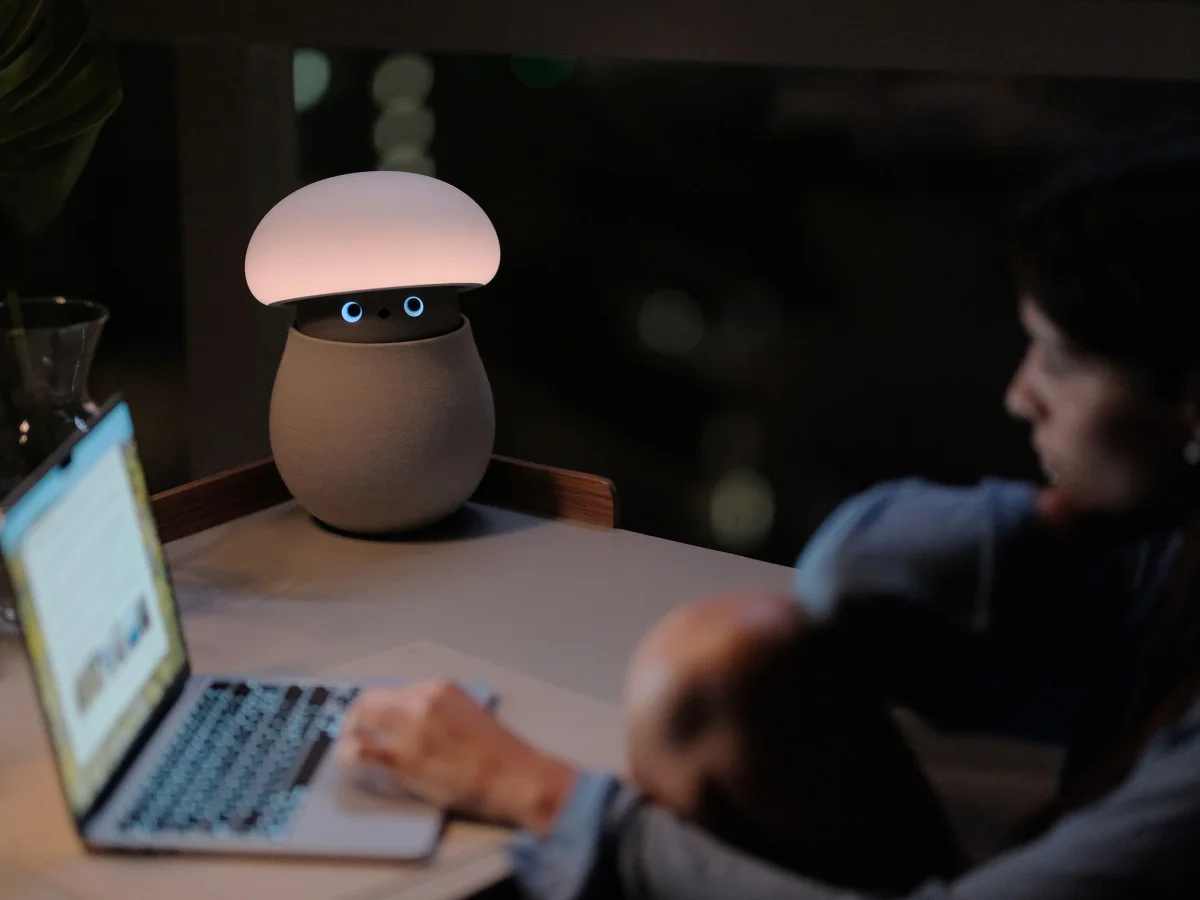
Mori’s appeal depends on a narrow idea of what a home robot should do: notice people, offer a little company and leave the rest of their attention alone. The mushroom-shaped device from OKA, or One Kind Artifact, combines a lamp with a camera, microphones and animated features. It can react to movement, play nature soundscapes and guide breathing exercises. It won’t answer questions or control other smart devices.
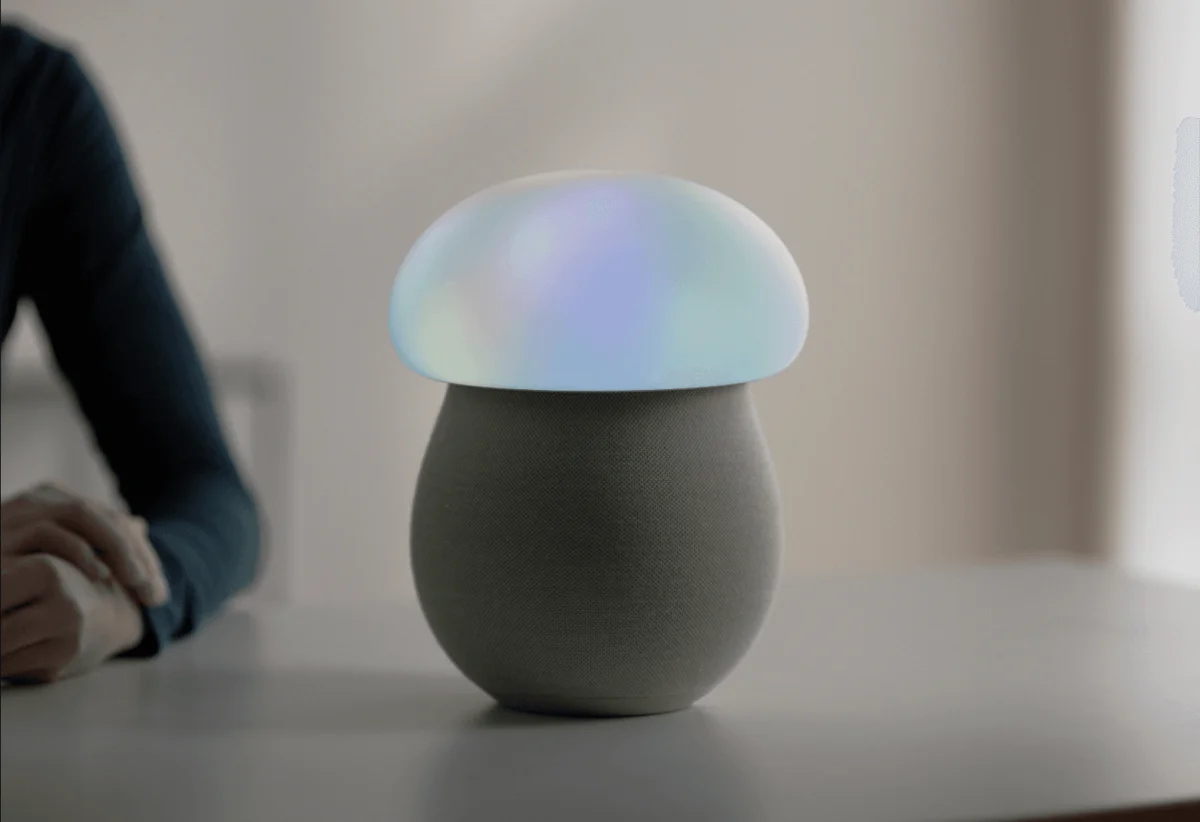
That limited role is the product’s defining choice—and its hardest sell. Mori is nearly 12 inches tall, can move its head and show round animated eyes, and makes soft, birdlike electronic sounds. When it detects someone returning to a room, it can perk up and jiggle. As someone moves around, its face follows. Touching its head retracts the camera and eyes, returning it to lamp mode.
A companion with a deliberately small job
OKA says Mori is meant to reconnect people with nature and their surroundings. Its light can shift through colors inspired by rain, forests, fire and wind, while nature audio provides the main relaxation feature. A breathing session is also available without a subscription. Mori can respond to music or television with small movements, and the company says users can ask it how an outfit looks and get an excited jiggle in response.
There’s no general-purpose voice assistant here. Mori can’t take voice commands to operate smart lights, start a Spotify track or report the weather. The design avoids the usual task-driven smart speaker routine; its role is closer to an interactive object that can draw a person’s attention or provide atmosphere. That makes the product’s value unusually dependent on whether someone enjoys having a responsive presence at home.
OKA is a new startup based in Cambridge, Massachusetts, and Shenzhen, China, focused on experimental technology. CEO Hua Wang says the company plans to make five experimental “Artifacts” over its lifetime, with Mori as the first. Before cofounding OKA, Wang was a general manager at Meipai, a video-sharing app from phone maker Meitu, and cofounded Bondee, a social app that briefly gained popularity in Asia.
What the sensors and software do
Mori uses its camera and microphones to interpret activity in a room. OKA calls the system “Attentive Intelligence” and says it runs multiple local large language models. The company describes the goal as deciding when the robot should interact and when it should stay quiet. It can remember people it has seen and behave differently around a guest; after a person has been absent for a month, Wang says, Mori forgets them.
Wang’s examples show how the product is intended to work: Mori might try to interrupt a long spell of phone use by inviting someone to listen to wind through leaves, then fall silent during a phone call or an argument. “All gadgets try to capture more of your attention,” he says. “Mori gives your attention back to you.” That claim rests on the robot’s ability to read context in a useful way, and on users accepting a camera-equipped device as a calming presence.
Privacy protections are part of that proposition. Wang says raw audio and images are processed on the device and discarded. Facial-feature data, used to distinguish a familiar person from a guest, is encrypted locally and never uploaded. The camera switches off when Mori’s sensor assembly retracts into lamp mode; double-tapping its head disables the microphone. Mori connects to Wi-Fi for firmware updates, according to Wang, and runs on battery or while plugged in.
Price, subscriptions and what comes next
The Founder's Edition costs $649, with a limited run of a few hundred units. It includes a two-year warranty and two years of Mori’s subscription service. After that, the service costs $17 per month or $80 per year. The standard edition costs $849, or $799 at the preorder price, and doesn’t include subscription features. Nature soundscapes require a subscription, so without one the core free feature is guided breathing, alongside Mori’s movement and light effects.
That pricing puts pressure on the distinction between a companion and a decorative lamp. Buyers paying for the standard version face an especially clear choice: subscribe for the soundscapes or keep a device that can move, glow and observe its surroundings without that part of the experience. OKA hasn’t shared a broader feature set or a schedule for additions.
Wang says future versions might connect to Oura Ring data to time relaxation sounds, or to Spotify to select audio. Voice controls could also arrive, letting someone request nature sounds without touching the device. These are possibilities he has raised, not current Mori capabilities.
The idea of a responsive household companion has older precedents. Carnegie Mellon University researcher Chris Harrison points to Sony’s Aibo, introduced in 1999, as an early digital pet. He argues that newer systems can respond to human actions and emotions in ways earlier robots couldn’t. Harrison also suggests that people may enjoy caring for a simple robot as they do a goldfish or hamster, without expecting it to perform sophisticated tasks.
That comparison frames Mori’s test: its success won’t hinge on how many commands it can handle, but on whether its limited interactions feel worth the price and the sensors in the room. OKA is betting that some people want a small, attentive presence more than another assistant. The product’s practical value will depend on whether that presence feels comforting after the novelty wears off.


