NVIDIA Expands Local AI Across RTX Spark, DGX Spark and DGX Station
NVIDIA adds local agents, model support and inference upgrades across its desktop AI systems, with new options for developers and enterprise teams.
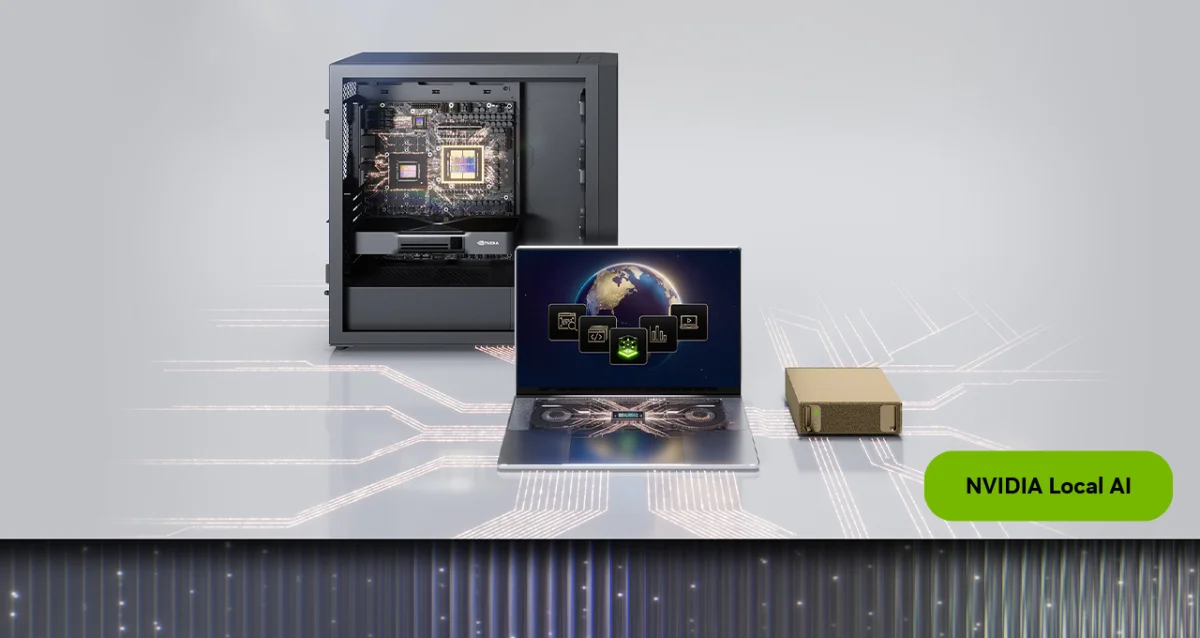
NVIDIA’s GTC Berlin announcements extend local AI across three systems: RTX Spark for personal agents and creative work on Windows PCs, DGX Spark for Linux development, and DGX Station for larger team workloads. The news spans hardware availability, model support, management tools and inference speedups. The practical shift is toward running more of the model and agent stack on devices or team systems, with shared capacity and enterprise software support becoming part of the offering.
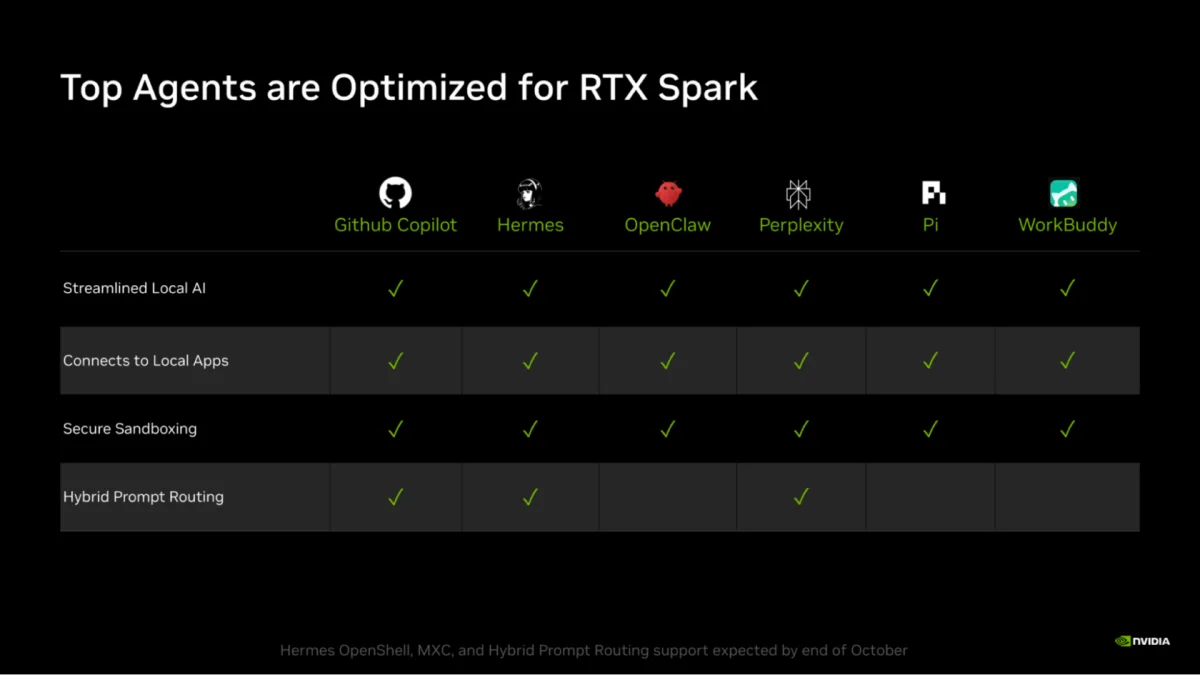
Personal agents on RTX Spark
NVIDIA says RTX Spark combines up to 128GB of unified memory with 1 petaflop of AI compute. The company positions it for local agents, accelerated content creation and gaming at 1440p and 100 frames per second. Systems from ASUS, Dell Technologies, HP, Lenovo, Microsoft and MSI are available; Acer is expected to follow. NVIDIA’s RTX Spark product page and developer playbooks provide product details and setup guidance.
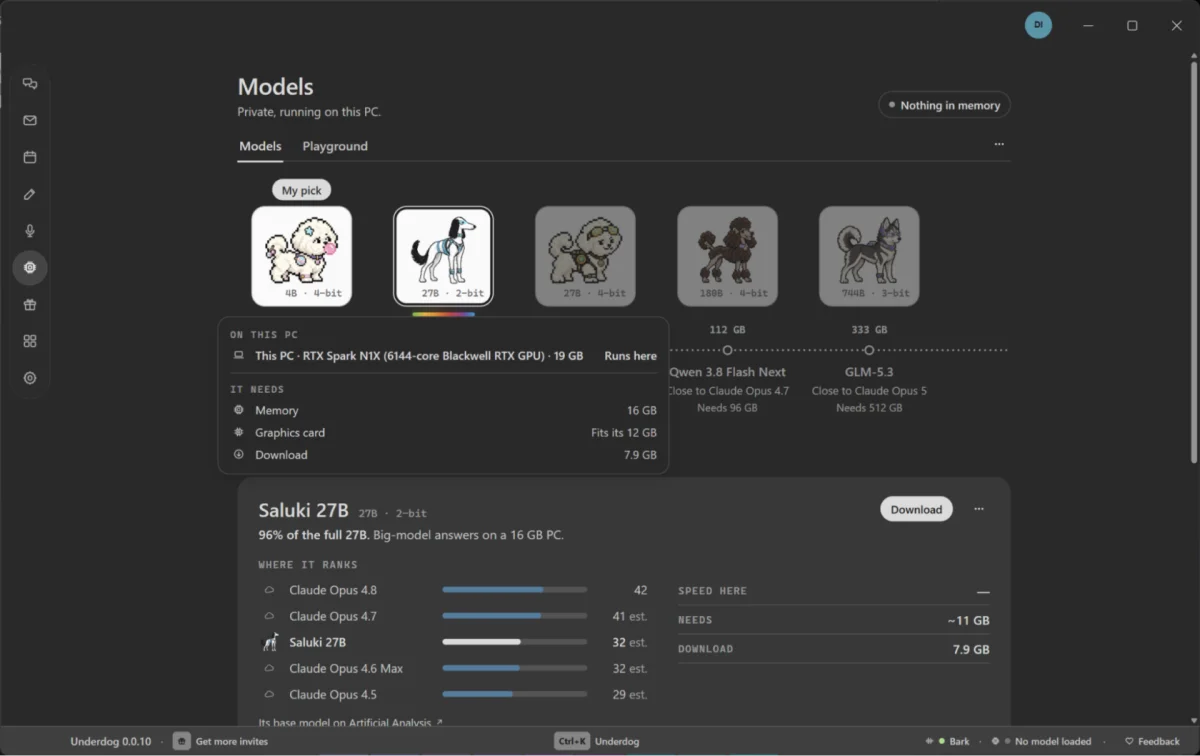
Underdog’s desktop agent app is now available for RTX Spark. Its Husky inference engine runs models on the device, allowing agents to process user data without sending it off the PC, according to the company. The app can be downloaded from Underdog. NVIDIA also says many RTX Spark laptops have unlocked bootloaders, giving developers and enthusiasts more room to configure the systems for local agent work.
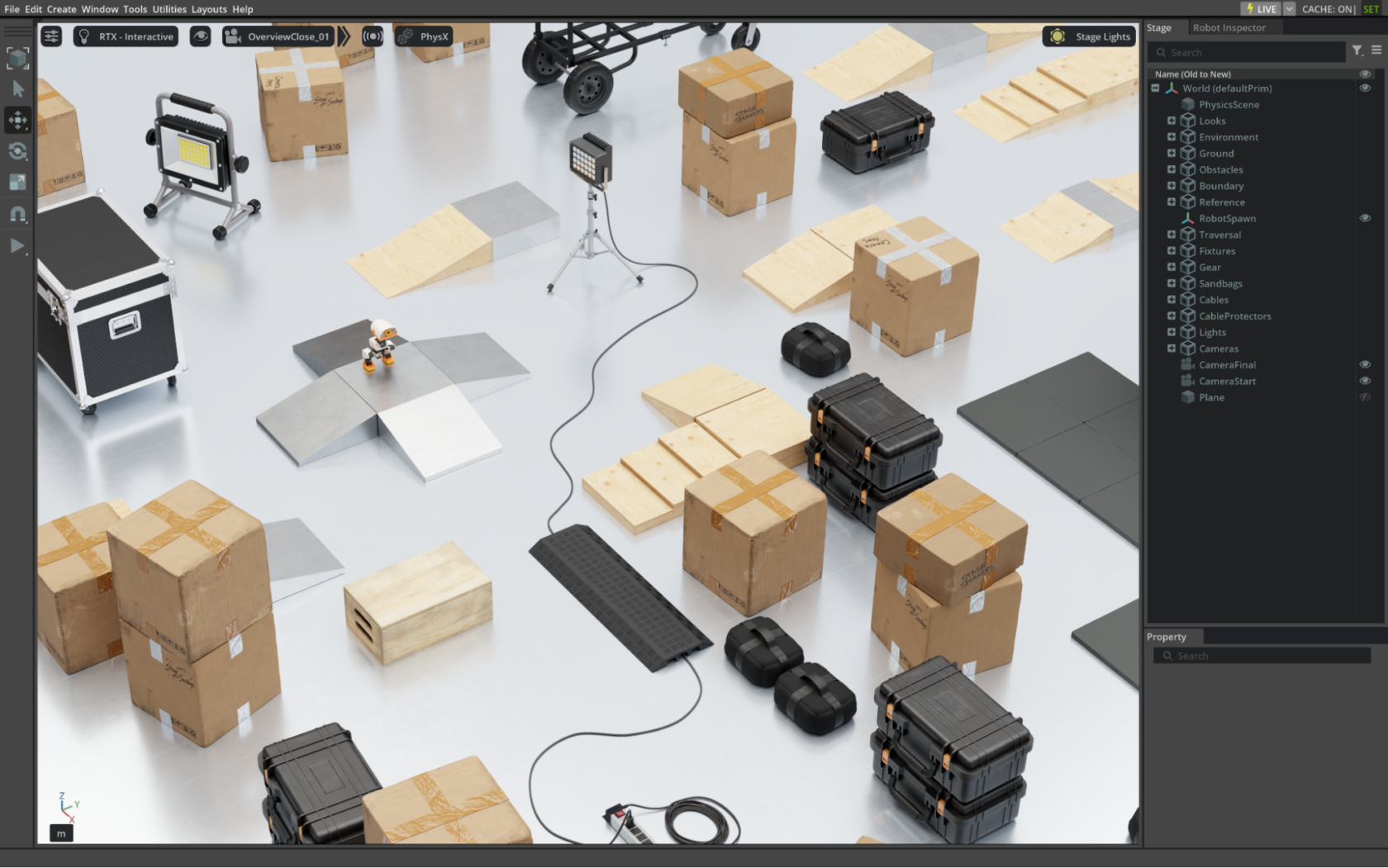
A keynote demonstration used agents running on RTX Spark to train Hugging Face’s Microduck robot with NVIDIA Isaac Lab, Hermes Agent and Nemotron 3.5 Bolt 74B. The demonstration points to a broader use for local systems: supporting development workflows that combine models, tools and physical devices. It does not, by itself, establish how the setup performs outside the demo.
NVIDIA says RTX Spark launched on October 16. Early reviews quoted by the company described it as suited to creators, AI work and portable use. Those descriptions offer initial impressions rather than measured comparisons; the announcement does not provide independent benchmark results for the hardware.
DGX Spark scales from one system to a cluster
DGX Spark systems with 64GB of memory begin rolling out through partners on Friday, Oct. 23. NVIDIA lists Nemotron 3.5 Bolt 74B 24GB, Qwen3.8 27B and Gemma 4 26B-A4B among the models they can run. Developers needing more memory can connect multiple systems over built-in ConnectX-7 networking and configure them with NVIDIA Sync Cluster Assistant. A company overview and cluster playbook describe the setup.
Manual configurations now support clusters of up to eight DGX Spark units, for a combined 1TB of unified memory. NVIDIA says this capacity can support larger models, longer contexts, multiple agents and distributed development, including models such as GLM 5.3. A shared cluster could let a small team run separate sessions against the same model; the actual experience will depend on workload and how the available compute is shared.
NVIDIA Sync’s Model Launcher is due later this month. It will download a model and compatible container for a single system or cluster, then connect the model to OpenCode. The tool will also load DGX Spark Skills, which provide workflow guidance for troubleshooting, maintenance and documentation. An October software update adds a Wi-Fi Assistant for changing networks while the system runs in appliance mode and brings those skills into Sync through OpenCode.
DGX Spark systems are sold by Acer, ASUS, Dell Technologies, GIGABYTE, HP, Lenovo, MSI and NVIDIA. This spread of configurations gives developers more ways to acquire the same platform, though the announcement does not compare prices or performance among systems.
DGX Station targets team workloads
DGX Station is aimed at larger workloads, with 748GB of coherent memory and up to 20 petaflops of AI performance. NVIDIA says the system can run models such as GLM 5.3 and serve more than 30 users at speeds comparable to cloud models. Sync now supports linking two Linux-based DGX Station systems. The announcement does not specify the conditions behind the user count or speed comparison, so teams will need workload-specific measurements before sizing a deployment.
Seven integrations are intended to fit DGX Station into existing IT processes: Absolute Security, Splunk by Cisco, Fleet Device Management, Microsoft Intune, Perforce Puppet, Progress Software Chef and Tanium. NVIDIA says these tools support setup and management workflows and can help teams reduce deployment risk and time to first token. For organizations with established device management, that support may matter as much as raw model capacity.
A Windows version of DGX Station is expected from system partners in December. NVIDIA says it will combine local models and agents with Windows-native software and NVIDIA RTX PRO GPUs in one system. Planned manufacturing application support includes nTop, Dassault Systèmes, Keysight Technologies, MathWorks, Rockwell Automation, Siemens, Synopsys, Unity and Altera, for design, simulation, validation and engineering automation. Users will also be able to run agents from Hermes Agent, Perplexity or Aible on premises. Windows systems are expected from ASUS, Dell Technologies, GIGABYTE, HP, MSI and Supermicro.
For robotics teams, NVIDIA describes DGX Station as dedicated compute for post-training, simulation and evaluation. Three open source reference workflows connect GPT-6 Astra with Isaac Lab, Isaac Lab-Arena and Cosmos. They cover reinforcement learning for GR00T 1.7, dexterous manipulation training and post-training Cosmos world models for synthetic data generation.
NVIDIA Cloud Functions is also planned for early access on Linux-based DGX Station. Through the service, teams will be able to register local model endpoints in a shared catalog and call them through one OpenAI-compatible interface. Applications can keep the same code when a team changes the model behind an endpoint, while colleagues can use shared models without direct access to the machine.
NVIDIA is previewing DSX OS on DGX Station at GTC Berlin to simulate AI factory operations before full infrastructure is available. A separate demonstration uses DGX Station systems as a local token service for more than 30 software developers. DGX Station systems are shipping from ASUS, Dell Technologies, GIGABYTE, HP, MSI, Supermicro and Exxact.
New models and inference work
Recursive Superintelligence has released Recursive Flint, a coding model with 40 billion parameters and 2.5 billion active parameters. The company says it performs well on SWE-Bench Pro v2, Terminal-Bench 2.1 and SWE-bench verified, but the announcement gives no scores for those evaluations. Recursive says its Eureka Machine automated a research loop of proposing ideas, implementing them and testing results. Specialized kernels developed through that process increased Flint’s generation speed on RTX Spark by 55% without changing the model weights.
The model’s open weights are offered under the Apache 2.0 license. Developers can run Flint on RTX Spark, DGX Spark, GeForce RTX and RTX PRO GPUs, and adapt it with NeMo Automodel for supervised fine-tuning or low-rank adaptation, and NeMo RL for group relative policy optimization.
NVIDIA is adding day-zero support for Nemotron Bolt E4B, models from GLM, DeepSeek, Qwen and MiniMax, Liquid AI’s LFM2.5-24B-A2B, and Black Forest Labs’ FLUX.3 Klein. Nemotron Bolt E4B is described as a 4-billion-parameter model that can fit in as little as 4GB of memory, with conversational and multi-turn agent skills. It is intended for voice assistants, game characters and embedded interfaces across GeForce RTX, Jetson, RTX Spark and DGX Spark; release is set for Friday, Oct. 23.
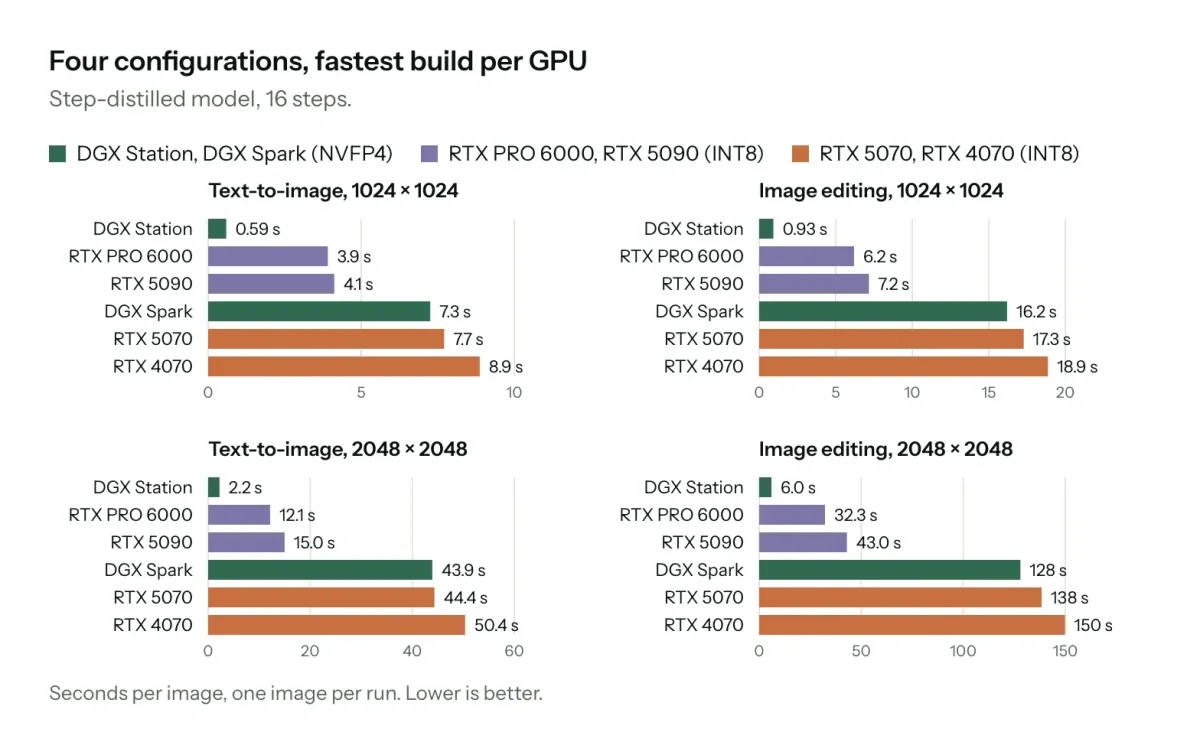
FLUX 3 Image Klein has 5.6 billion parameters and supports image generation and editing. NVIDIA says its optimized build can run on GeForce RTX GPUs with 8GB of VRAM and generate a one-megapixel image in about four seconds on an RTX 5090. MiniMax M3.1 Flash is described as an open model for DGX Station and DGX Spark with long-context support. Liquid AI’s open-weights LFM2.5-24B-A2B activates 2 billion of its 24 billion parameters per token, a design intended to make private, tool-calling agents practical on PCs.
NVIDIA has also published checkpoints optimized for memory use, leaving room for KV cache while aiming to stay close to full-precision accuracy. The collection starts with Qwen3.8-Flash-Next-FP4-Local for one 128GB DGX Spark or an RTX PRO 6000, and GLM-5.3-Flash-FP4-Local for two systems. Developers can post-train supported models on DGX Spark and RTX Spark with NeMo AutoModel; example recipes cover Nemotron Bolt E4B and Flux 3 Image Klein.
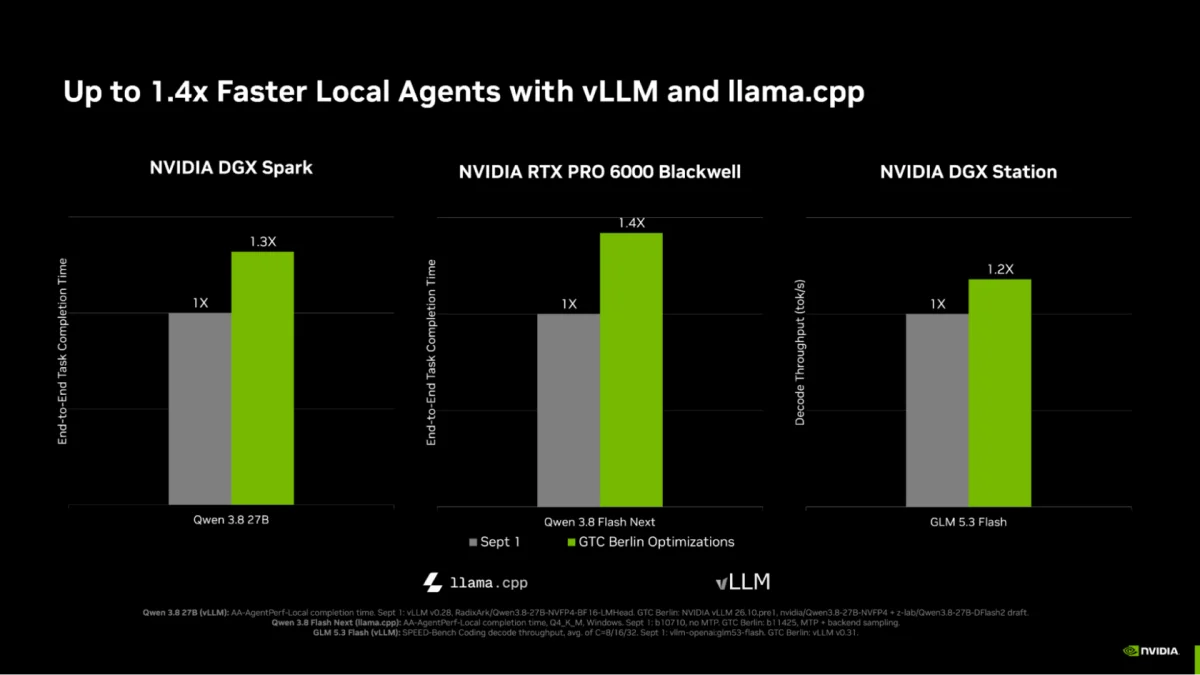
Inference updates target llama.cpp and vLLM. In llama.cpp, speculative decoding with MTP for Qwen 3.8 Flash Next makes agentic tasks up to 1.4 times faster on RTX PRO 6000 Blackwell, according to NVIDIA. In vLLM, faster speculative decoding and FlashInfer prefill kernels for Qwen’s linear-attention layers make Qwen3.8 27B agentic tasks up to 1.3 times faster on DGX Spark. On DGX Station, GLM 5.3 Flash reaches up to 1.2 times higher throughput. Developers can try the changes through NVIDIA’s local inference recipes.
Taken together, the announcements build a local AI stack around hardware, model distribution, deployment tools and inference optimization. The next useful test is how these systems perform on teams’ own workloads, especially when memory, concurrency and software integration shape the cost of keeping inference close to users and data.


