Claude-Assisted Oblivion Remastered Mod Reports Performance Gains up to 68%
A reverse-engineered mod targets stutter and frame-rate problems in Oblivion Remastered, with reported gains reaching 68% in the worst case.
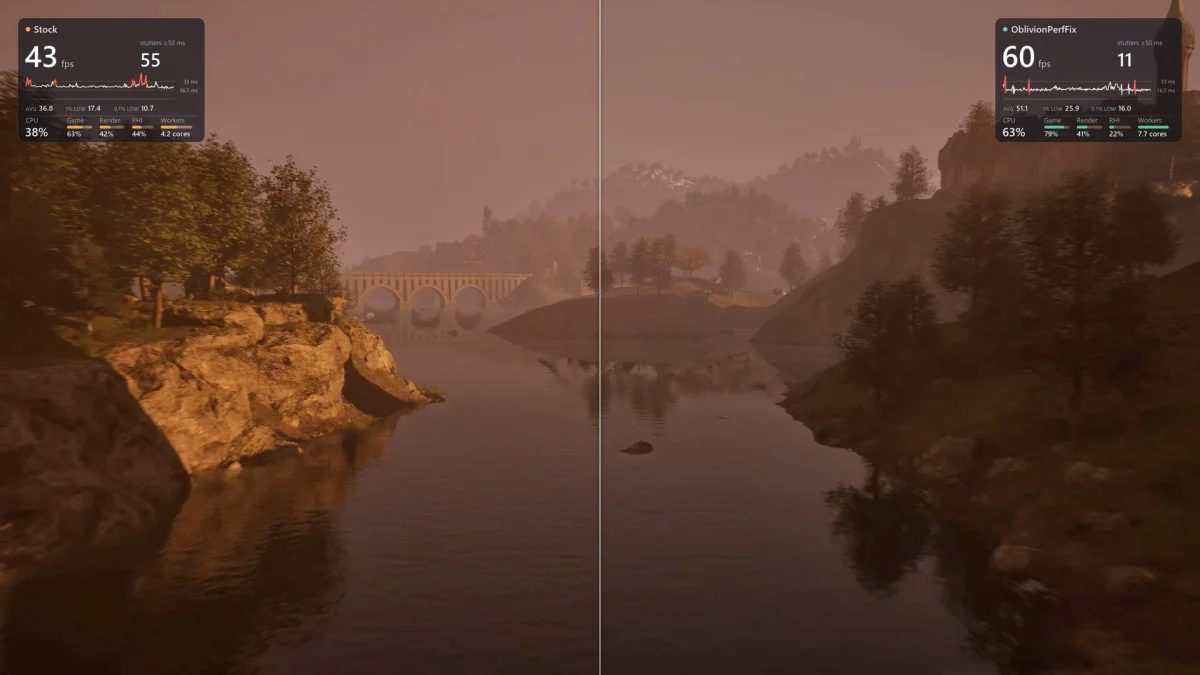
The Elder Scrolls IV: Oblivion Remastered may have significant performance headroom that a community mod can recover without changing the game’s visuals. The Oblivion Remastered Performance Fix, developed by LTSharpe with help from Anthropic’s Claude, reports gains of up to 68% in the worst case. Its other target is the hitching that players have reported across the game, particularly while moving through the overworld.
Those results come from one creator’s testing, so they shouldn’t be read as a guaranteed improvement across every PC. Still, the project stands out for its method: LTSharpe used a repeatable benchmark to investigate the game’s behavior and test changes to its machine code, working without access to the game’s source code. That gives the mod a more specific technical basis than a collection of unverified settings tweaks.
Reverse engineering to find the bottlenecks
LTSharpe began with a Ryzen 7 5800X system and frustration with the remaster’s uneven performance. The processor uses AMD’s Zen 3 architecture; the account doesn’t describe it as a new high-end chip, but it should still be capable of running modern games. To investigate what was going wrong, LTSharpe subscribed to Anthropic’s Claude AI agent and worked with it to diagnose the problems.
The pair first built a repeatable way to benchmark the game. That step matters because it gives them a consistent basis for comparing behavior before and after a change. With a test framework in place, they could examine the game’s performance, identify possible causes and check whether modified machine code changed the results.
Neither Oblivion nor the remaster’s Unreal Engine code is open source, so the work involved studying the game from its compiled form. According to LTSharpe, Claude helped diagnose and fix issues over two weeks across several parts of the software stack: the remaster’s Unreal Engine code, the original Gamebryo engine beneath it, AMD’s frame-generation code and Unreal Engine itself. The reported outcomes include better performance and fewer crashes.
That scope is notable, but the account doesn’t establish that Claude can independently repair arbitrary games. LTSharpe directed the work, supplied a particular system for testing and evaluated changes against the game’s behavior. The result is better understood as a developer using an AI assistant in a demanding reverse-engineering process than as a fully automated repair tool.
Reported results and hardware limits
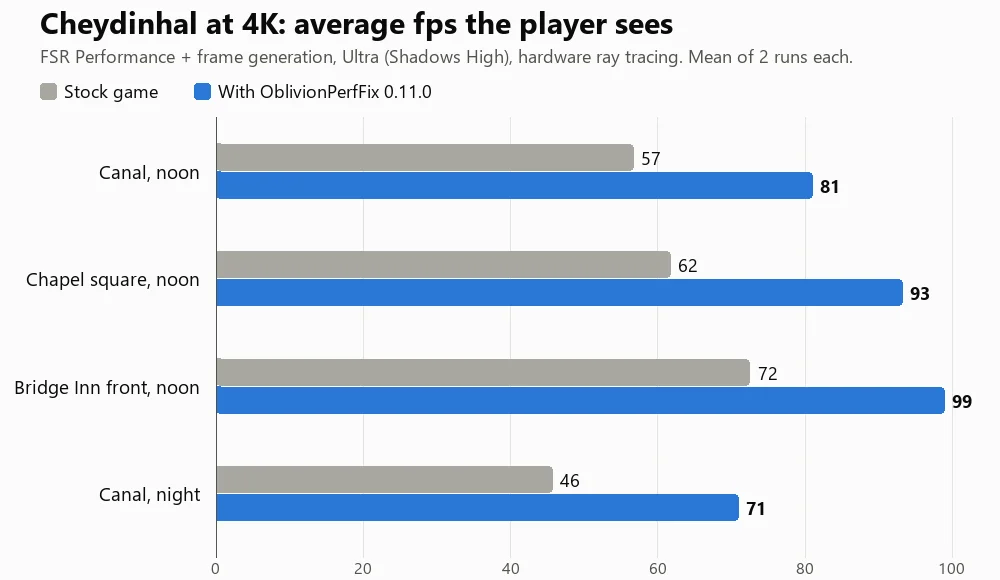
The project’s benchmark image compares the game’s performance before and after the mod, while the headline figure in the account is a maximum improvement of 68% in the worst case. Players posting on NexusMods have also described smoother play. One user called the increase “dramatic” and said the overworld stuttering was “completely gone.” Those comments are individual reports, not a controlled measure of how the fix performs across a broad range of systems.
LTSharpe has cautioned that the changes were developed with his own setup in mind and may behave differently on other PCs. His system includes a Radeon graphics card, a configuration the source describes as a minority among PC players. Some fixes focus on keeping AMD’s FSR upscaling and frame generation active after players switch away from the game with Alt+Tab. A long-standing game bug can disable those features when the player returns.
That makes hardware and settings relevant to whether a player sees the same results. A fix tailored around Radeon features may have less effect on a system with different graphics hardware, and the account doesn’t provide results across a range of processors or graphics cards. The reported maximum is therefore a useful signal of what the mod achieved in testing, rather than a promise of a similar gain for every installation.
A practical test for AI-assisted development
The project illustrates a grounded use of an AI coding assistant: helping one person work through unfamiliar, closed-source software by supporting diagnosis, benchmarking and code changes. The difficult part wasn’t simply producing a patch. It was building a repeatable test, tracing problems across multiple engine components and checking whether each change improved the game without introducing instability.
The mod is available through NexusMods, where LTSharpe is also responding to users and asking players to report their results. Those reports can help show how well the fixes carry over to different hardware. For now, the clearest takeaway is that this remaster’s stutter and performance problems may have more than one cause—and that targeted reverse engineering has produced a promising fix on at least one Radeon-based system.
For developers watching AI-assisted coding, the more durable lesson is the workflow: establish a benchmark, investigate the compiled program and validate each proposed fix against measured behavior. Whether the reported gains generalize will depend on testing beyond the creator’s machine.


