LangChain vs. LlamaIndex vs. Custom LLM Apps: Choosing the Right Build Path
LangChain speeds broad prototyping, LlamaIndex focuses on retrieval, and custom code offers control. The right choice depends on your use case and team.
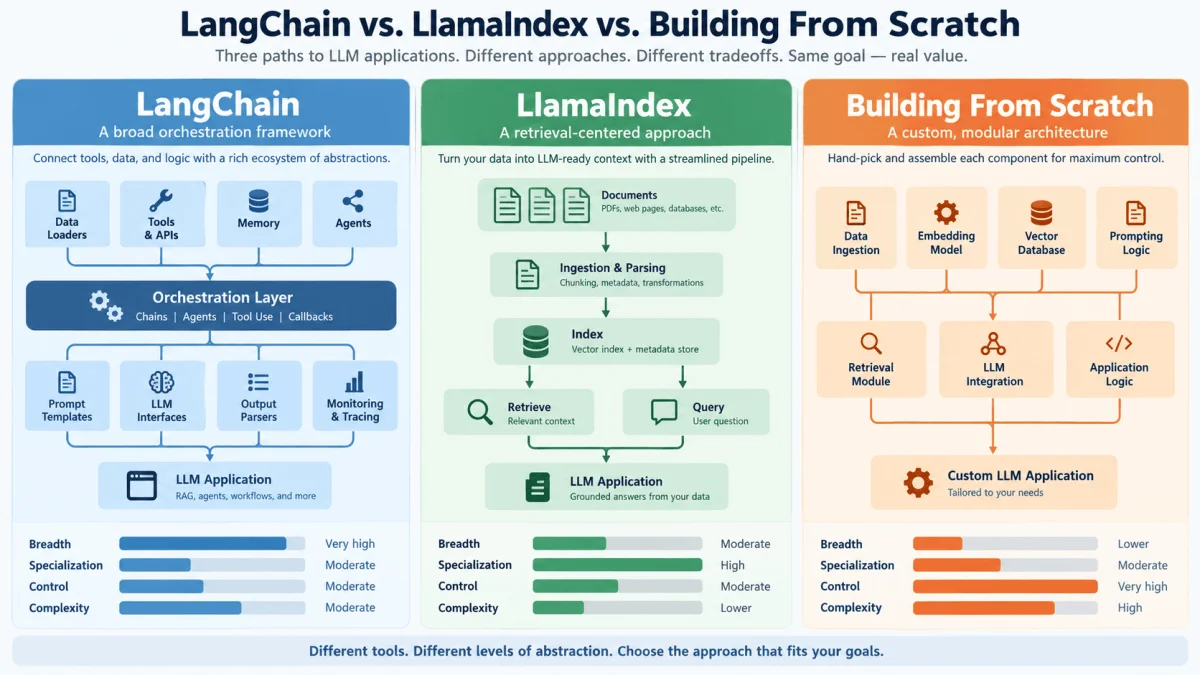

Choosing an LLM development framework is a tradeoff between how quickly a team can explore an idea and how much control it needs over the finished system. LangChain offers a wide set of integrations and orchestration tools; LlamaIndex concentrates on retrieval; and direct use of model and data APIs keeps the implementation in your hands. None is the default answer for every project.
The decision is easier when framed around the work the application must do, the team’s experience, and the project’s stage. A framework can accelerate early experiments, but its abstractions may become constraints as requirements sharpen. Custom code takes more effort at the start, yet can make production behavior easier to inspect and adapt.
What an orchestration layer provides
An LLM API accepts input and returns output; it does not, by itself, manage an application’s broader flow. A document question-answering product may need to retrieve relevant passages, fit them into a prompt, and return a grounded response. An agent may need to select tools, process intermediate results, and decide what to do next. Those steps require orchestration: context handling, retrieval, routing, memory, and coordination between operations.
LangChain and LlamaIndex provide components for that work. Building without a framework means choosing and connecting those components directly, then maintaining the logic yourself. The difference is not whether a team builds an application, but how much of its underlying machinery it delegates.
LangChain favors breadth
LangChain’s main advantage is the range of patterns and services it connects. Its abstractions cover chains, agents, memory, tools, retrievers, output parsers, and prompt templates, alongside integrations with databases, search services, APIs, and other providers. For a team still discovering what its product needs, that breadth can make it easier to try several directions.
Its agent tools also offer a starting point for workflows where a model chooses among tools, responds to results, or runs a sequence of actions. Developers can explore those patterns without first writing every decision loop and integration themselves. Documentation and community examples provide further help for common use cases.
The same surface area can make behavior harder to trace. Abstractions may wrap requests and responses across several layers, so diagnosing a failure can require following the framework’s internal path. The gap between a quick initial build and later debugging or customization is a common source of friction.
Fast development also brings a maintenance cost. LangChain has changed quickly; older tutorials may show patterns that no longer apply, documentation can lag behind changes, and upgrades can introduce compatibility work. That matters when a system depends on stable, predictable behavior. LangChain is a natural fit for exploration, broad integrations, and projects where implementation control is less urgent than trying ideas quickly.
LlamaIndex centers on retrieval
LlamaIndex began as GPT Index, with a narrower aim: connecting data to LLM applications. Retrieval-augmented generation (RAG), in which a system fetches relevant information and supplies it as model context, remains its strongest area. Its connectors, indexing methods, and query engines are designed around that workflow.
That focus shows up in its support for more involved retrieval patterns, including re-ranking, hybrid search, hierarchical retrieval, and query routing. These techniques can help document question-answering tools, knowledge assistants, and enterprise search systems handle cases a basic retrieve-and-answer pipeline may miss.
Evaluation tools are another useful part of the package. A retrieval system’s output can sound fluent even when the retrieved context is poor. Teams need ways to assess whether the system finds useful material before relying on it in an application, and LlamaIndex’s evaluation support addresses that part of development.
Its focus is also a boundary. Applications built around complex tool use or agent behavior may not align as neatly with LlamaIndex’s assumptions. Even a well-shaped abstraction can become cumbersome when a project needs to work outside the pattern it was designed to support.
Custom code offers control and responsibility
Building from scratch means using model-provider APIs directly and implementing the retrieval and orchestration the application actually needs. It does not mean training or creating an LLM. Providers such as OpenAI, Anthropic, and Google offer APIs and client libraries, while vector database services including Pinecone, Weaviate, and Qdrant supply their own SDKs. A team assembles these parts without adopting a larger framework.
The payoff is visibility. Developers can inspect how prompts are formed, when requests are retried, how context is selected, and where decisions occur. When a system behaves unexpectedly, a smaller, team-owned set of abstractions can make the source of the problem easier to find. Direct control also helps when requirements call for domain-specific prompts, custom retrieval, specialized context management, or performance tuning.
Writing only the needed components can clarify the design, too. Frameworks make sophisticated patterns easy to reach for; a direct implementation forces a team to decide which patterns its use case requires. That discipline may limit unnecessary complexity, provided the team understands the parts it is building.
The cost is front-loaded engineering time. Developers must make more decisions and write code that a framework might have supplied. That can slow early learning when the team has not yet established whether the application is useful. A custom RAG system also calls for practical knowledge of embeddings, vector similarity, chunking, and context-window limits. Frameworks can obscure these topics, while a direct build makes them harder to avoid.
Match the approach to the work
For early exploration, a framework usually helps a team test assumptions faster. LangChain suits projects whose requirements are still broad or uncertain; LlamaIndex is a stronger starting point when document retrieval is clearly central.
For a retrieval-heavy system approaching production, LlamaIndex merits a close look. Its focus can keep its abstractions aligned with the core task, and its evaluation tools can help teams examine retrieval quality as the system develops.
For a team with clear requirements and strong engineering experience, direct implementation can be a better long-term choice. The initial work buys more room to debug, tune performance, and adjust the architecture as needs change. Deep customization at any layer is also a signal to plan for custom code, whether from the beginning or as a later step.
These choices can change over a project’s life. A team might prototype with LangChain, learn which parts matter, then replace core retrieval and orchestration with its own code while retaining selected integrations. That path can preserve early speed while bringing the most important behavior under direct control.
Resources for comparing approaches
The LangChain documentation describes chains, agents, and integrations. The LlamaIndex documentation covers RAG patterns, indexing, and evaluation. To understand what direct API use offers, read Anthropic’s prompt engineering guide and the OpenAI Cookbook. Pinecone’s learning center explains vector search and retrieval independently of a particular framework.
The most useful choice comes from locating the application’s complexity: retrieval, tool use, integration breadth, or custom control. Pick the approach that fits that work and the team’s ability to maintain it, then revisit the decision as the requirements become clearer.
Vinod Chugani is an AI and data science educator focused on agentic AI, machine learning applications, and automation workflows. His work includes technical mentoring and instruction for data professionals, drawing on experience in quantitative finance.
- Comparative Analysis of LangChain and LlamaIndex
- Building a RAG Application Using LlamaIndex
- Building a Custom PDF Parser with PyPDF and LangChain
- Building Agentic Application Using Streamlit and Langchain
- Getting The Most From The LangChain Ecosystem
- How to Implement Agentic RAG Using LangChain: Part 2


