AI Product Manager Roadmap: Technical Fluency, Evaluation and Scale
A four phase path for AI product managers, from model tradeoffs and cost planning to user evaluation and cross team leadership.
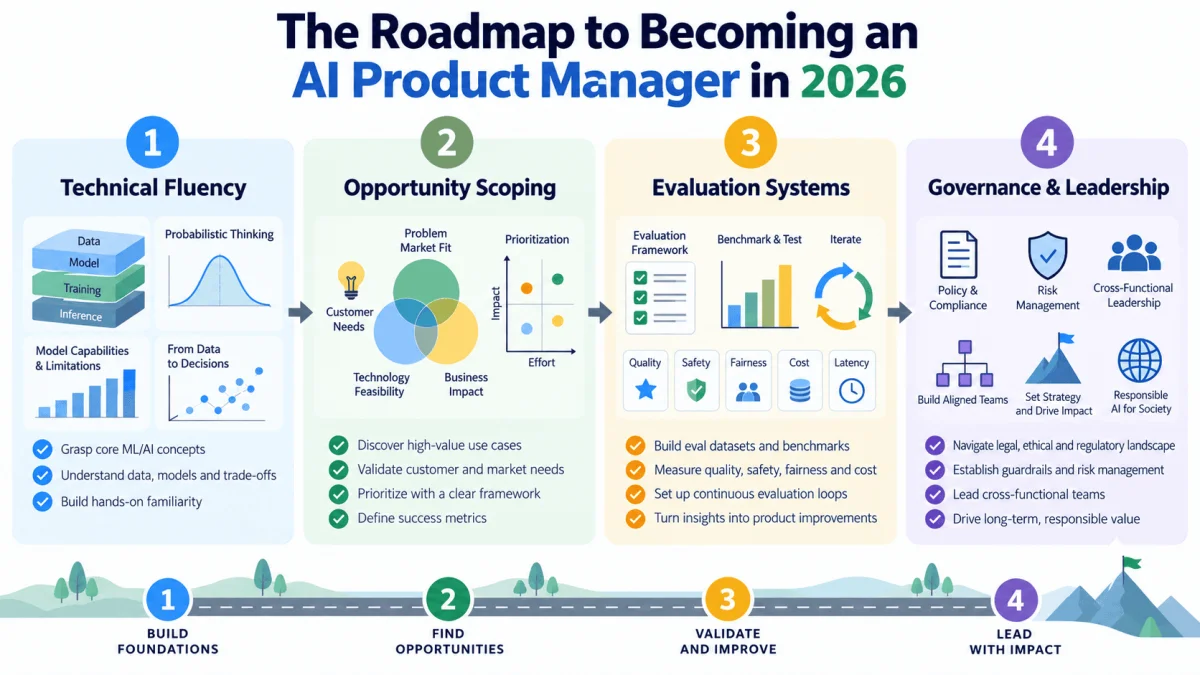

The hardest part of shipping an AI feature often starts after the prototype works: turning variable model output into a product people can rely on at a cost the business can sustain. That makes AI product management a discipline of tradeoffs. Product managers need enough technical understanding to scope the work, enough measurement discipline to see whether it helps, and enough organizational influence to bring different teams along.
A useful way to build those skills is in four stages: learn how AI systems behave, choose worthwhile use cases, design and evaluate the user experience, then coordinate the work needed to operate at scale. The stages overlap in practice, but each provides a foundation for the next.
Start with how AI systems behave
Conventional software is often designed around predictable outputs. AI systems produce results that are approximate and sensitive to context. A product manager has to plan for that variability: an answer can be useful in one situation and wrong in another. The goal isn't to eliminate uncertainty by assumption, but to understand where it matters and how the product should respond.
That calls for working knowledge of several common approaches. Foundation model APIs from providers such as OpenAI, Anthropic and Gemini can speed up development, with less control over the underlying model and recurring costs tied to use. Fine-tuning open-weight models with LoRA or PEFT can adapt them to specific tasks. Retrieval-augmented generation, or RAG, supplies documents that ground a model's answers. Smaller language models running locally may suit products with strict latency or privacy needs.
Product managers don't need to build these systems themselves. They do need to ask informed questions about the choice: what level of control is needed, how will answers be checked, and what happens to performance and expense as usage grows? Latency, cost and accuracy pull against one another. Token use, time to first token and context window size can shape both the user experience and the operating bill.
For a first project, compare three architectures for one business task, such as customer support automation. Write down why each might fit and what tradeoffs it introduces. Hands-On Large Language Models by Jay Alammar and Maarten Grootendorst and the fast.ai Practical Deep Learning course can help build this technical intuition.
Choose opportunities with care
Once the core concepts are clear, the central question becomes whether a task is a good fit for AI at all. The AI Product Canvas frames that decision around two considerations: the value of a good result and the cost of a bad one. Classification, summarization and document extraction may be sensible early projects when errors are manageable. Tasks with serious consequences or irreversible outcomes call for stronger safeguards and much more evaluation before release.
Next comes the choice to build, buy or assemble a solution. A commercial API may be the fastest route; an open-weight model may fit better when control or margins matter; and specialized software may be a stronger option for a narrow field. The right answer depends on the task, team capabilities and expected volume.
Cost analysis needs to reach the inference layer. Estimate how token consumption affects gross margin as use increases. Compare GPU hosting with per-call API charges at a substantially higher volume, and include the expense of vector database queries and retrieval depth. A compelling demonstration can obscure costs that become material when real users arrive.
Practice by writing a one-page recommendation for a use case in an industry you know, including a simple token cost projection. Teresa Torres's Continuous Discovery Habits offers a framework for finding and assessing opportunities. The a16z AI Canon provides market context, while Anthropic's pricing page and OpenAI's API pricing can inform cost estimates.
Design for uncertain results, then measure them
AI features need a different approach to product quality than simple pass-or-fail checks. Teams need to design for uncertainty: explain limits without confusing users, offer a useful fallback when the model misses, and decide where a person should review or approve an output. Feedback can come from direct ratings as well as user behavior, but the team needs to know how those signals will improve the product.
Evaluation should begin before repeated development cycles. Create a set of representative inputs with expected outputs, then establish baseline results to catch regressions. Automated measures such as BLEU, ROUGE, precision and recall can help with particular tasks. LLM-as-a-Judge pipelines may offer a useful additional signal, though the measure should fit the feature being assessed.
Model scores matter only when they connect to product outcomes. A change in ROUGE, for example, needs to be linked to a measure such as resolution rate, escalation rate or retention before it can guide a product decision. Human review can add context that automated scoring misses.
Adversarial testing belongs in the release process. Probe for prompt injection, test the system's boundaries and simulate difficult cases before users encounter them. A practical portfolio exercise is to create an evaluation rubric for a specific feature, with at least three automated measures and a plan for human review. Chip Huyen's Designing Machine Learning Systems, the RAGAS documentation, Braintrust and PromptFoo offer material and tools for this work.
Coordinate teams as products grow
At larger organizations, the job expands from feature decisions to keeping technical, business and risk concerns aligned. Research engineers may focus on benchmarks, legal teams on exposure, and executives on revenue and operational risk. The product manager has to preserve the details as information moves between those groups.
Data handling is part of product design. Teams should understand what customer information goes to external model providers, what sanitization happens first and how users can opt out. In enterprise settings, requirements such as SOC 2 and HIPAA can affect architecture choices. Product managers don't need to replace specialists, but they should spot questions early and bring the right people into decisions.
A one-page risk review of a product you use is a useful exercise: identify one concern related to its operating environment, one about data privacy and one about the user experience. The Future of Life Institute's summary of the EU AI Act, Kush R. Varshney's Trustworthy Machine Learning and existing organizational documentation can provide starting points for learning.
Build a learning loop
The role is still taking shape, so a portfolio of practical work can demonstrate judgment better than a list of tools. Alongside the exercises above, useful references include Continuous Discovery Habits, Designing Machine Learning Systems and Hands-On Large Language Models; fast.ai's course and Reforge's AI Product Management track; and communities such as Lenny's Newsletter, the Latent Space podcast and The AI Product Institute. For evaluation and observability, explore Braintrust, PromptFoo, RAGAS and Weights & Biases.
Strong AI product managers are candid about what a model can and can't do. They plan fallbacks, connect evaluation to user and business outcomes, and keep revisiting the tradeoffs as systems and costs change. The practical habit is to treat measurement and trust as part of the product from the beginning.
Vinod Chugani is an AI and data science educator focused on practical applications, technical mentoring and career development. His work includes agentic AI, machine learning applications and automation workflows.
Related reading
- The Roadmap to Becoming an AI Architect in 2026
- The Roadmap to Becoming an LLM Engineer in 2026
- The Ultimate Roadmap to Becoming an LLM Engineer
- Roadmap for Becoming a Data Scientist
- Ultimate Roadmap to Becoming a Tech Professional with Harvard for Free
- The Ultimate Roadmap to Becoming Specialised in the Tech Industry


