NVIDIA DGX Spark 64GB Brings Local AI Models Up to 100 Billion Parameters
The $4,999 DGX Spark 64GB runs models locally and can pair with a second unit for 128GB pooled memory and up to 1.7x performance in NVIDIA’s test.
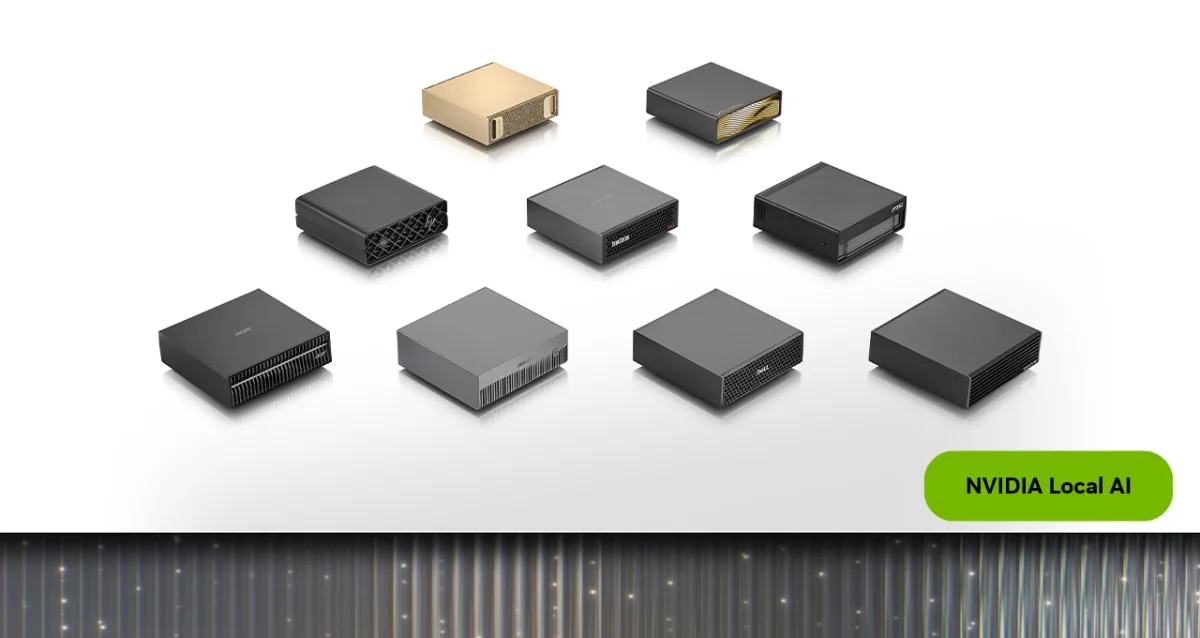
NVIDIA’s new 64GB DGX Spark configuration lowers the memory entry point for its compact Grace Blackwell system while keeping the same GB10 chip, operating system and AI software stack as the 128GB model. NVIDIA says a single unit can run models with up to 100 billion parameters locally; two connected systems pool 128GB of memory and can support models with up to 200 billion parameters.
The systems are available from Acer, ASUS, Dell, Gigabyte, HP and MSI starting Friday, Oct. 23, at $4,999. That price puts the configuration within reach of teams that want a dedicated local inference and development machine, though model size alone won’t tell buyers how quickly a system can serve a particular workload. Runtime, context length and concurrent requests also shape performance.
One system for local development
DGX Spark combines NVIDIA Grace Blackwell compute, unified memory, ConnectX-7 networking and a CUDA-accelerated software stack in a compact system. NVIDIA positions it for model inference, fine-tuning, data science, agent development and edge work. Its central appeal is that developers can test models against their own data on a dedicated machine without sending every task to a cloud service.
The 64GB version includes DGX OS and NVIDIA’s AI software stack. NVIDIA lists its Agent Toolkit, CUDA-X AI libraries and Nemotron open models among the included tools, alongside support for Ollama, vLLM and PyTorch with CUDA. It also names llama.cpp and LM Studio as supported inference frameworks in its setup guidance. The goal is a short path from initial setup to running a model, with familiar tools available for different serving and development workflows.
That ready-to-run setup may matter as much as the memory capacity for developers evaluating a local system. A machine can be technically capable of loading a model yet still require time spent installing frameworks, sorting out drivers and configuring networking. NVIDIA’s software bundle is meant to reduce that work, although the source does not provide independent setup-time measurements or comparisons with other systems.
Blender is among the first creator application providers named as supporting DGX Spark. A downloadable installer is planned, but the article gives no release date or details about which Blender workloads will be supported. For now, the clearest use case is running AI models locally while other applications use their own computers for editing, coding or research.
What clustering adds
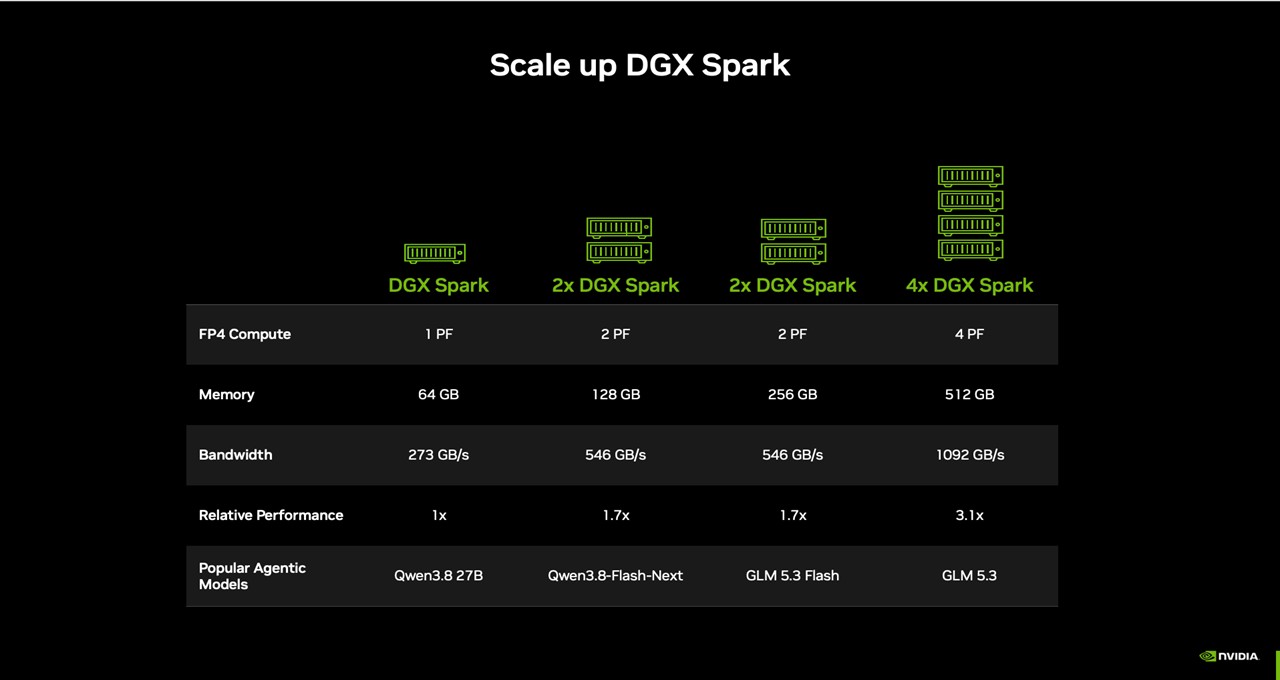
Two DGX Spark units can connect directly over their ConnectX-7 ports using a QSFP cable. NVIDIA says the pair pools its memory to 128GB, expands supported model size to as many as 200 billion parameters and provides twice the memory bandwidth. The article describes the connection as a 200 GbE fabric and says the software environment carries across both systems without reconfiguration.
NVIDIA Sync Cluster Assistant handles setup: it detects the connected units, checks their configuration and configures the network. In NVIDIA’s Qwen 3.8 27B test, two clustered 64GB systems delivered up to 1.7 times the performance of one system. That figure is a company-reported result for a named model and test; the article does not specify the workload, measurement method or performance of other models. Buyers should treat it as an indicator of possible scaling, not a general speed guarantee.
More memory can let a team run a larger model or accommodate a longer context window, while added capacity can also help with concurrent requests or multiple agents. Those benefits depend on how a workload uses the machines. The source does not give power consumption, noise, throughput, latency or a detailed cost comparison with cloud instances, so those remain practical considerations for anyone weighing a local purchase.
Agent and application workflows
NVIDIA describes several ways to use the system: keep a coding or research agent available for repeated tasks; run language or image generation on DGX Spark while a laptop handles the surrounding application; or connect a second unit when a model or workload exceeds one system’s capacity. These are usage examples rather than measured evaluations, and the source does not report task accuracy or reliability.
NVIDIA Sync Model Launcher is planned for the end of the month. The launcher is intended to download and start Qwen3.8 27B on one DGX Spark or a cluster, configure it across connected systems and make it accessible from users’ laptops. NVIDIA also says it will set up OpenCode so developers can work with the model in a browser. These features may reduce setup friction, but their availability and performance will need to be assessed once released.
Availability and setup
DGX Spark 64GB is listed through Acer, ASUS, Dell, Gigabyte, HP and MSI, with a starting price of $4,999. NVIDIA’s suggested setup is to install an inference framework, choose a model suited to the task and, for a two-system configuration, connect the network ports and launch Sync Cluster Assistant.
Playbooks for agent workflows are available for NemoClaw, OpenClaw, Hermes Agent and OpenShell. NVIDIA says guides for serving models with vLLM, running OpenClaw with a local model and connecting multiple DGX Spark systems are planned for 64GB devices. Its broader DGX Spark playbooks provide further workflow material.
The 64GB option makes the platform’s local development and inference workflows available at a lower memory capacity than the existing 128GB model. For teams choosing between one unit and a pair, the useful next evidence will be workload-specific performance, software support and the cost of running the hardware over time.
NVIDIA also points to RTX Spark systems planned from Acer, ASUS, Dell, HP, Lenovo, Microsoft and MSI, with updates via its RTX Spark newsletter. Alibaba’s Qwen-Image-2.1 is described as an open-weight image generation and editing model that can run locally on NVIDIA RTX GPUs, DGX Spark and DGX Station.
Related updates are shared on X, Instagram, TikTok and Facebook, as well as through the NVIDIA Local AI newsletter and NVIDIA Workstation accounts on LinkedIn and X. Software product information is subject to the linked notice.


