NVIDIA and Microsoft Bring Local AI Agents to Windows PCs With RTX Spark and DGX Station
RTX Spark targets local AI across laptops and compact desktops, while DGX Station for Windows brings up to 20 petaflops of FP4 compute to the desktop.
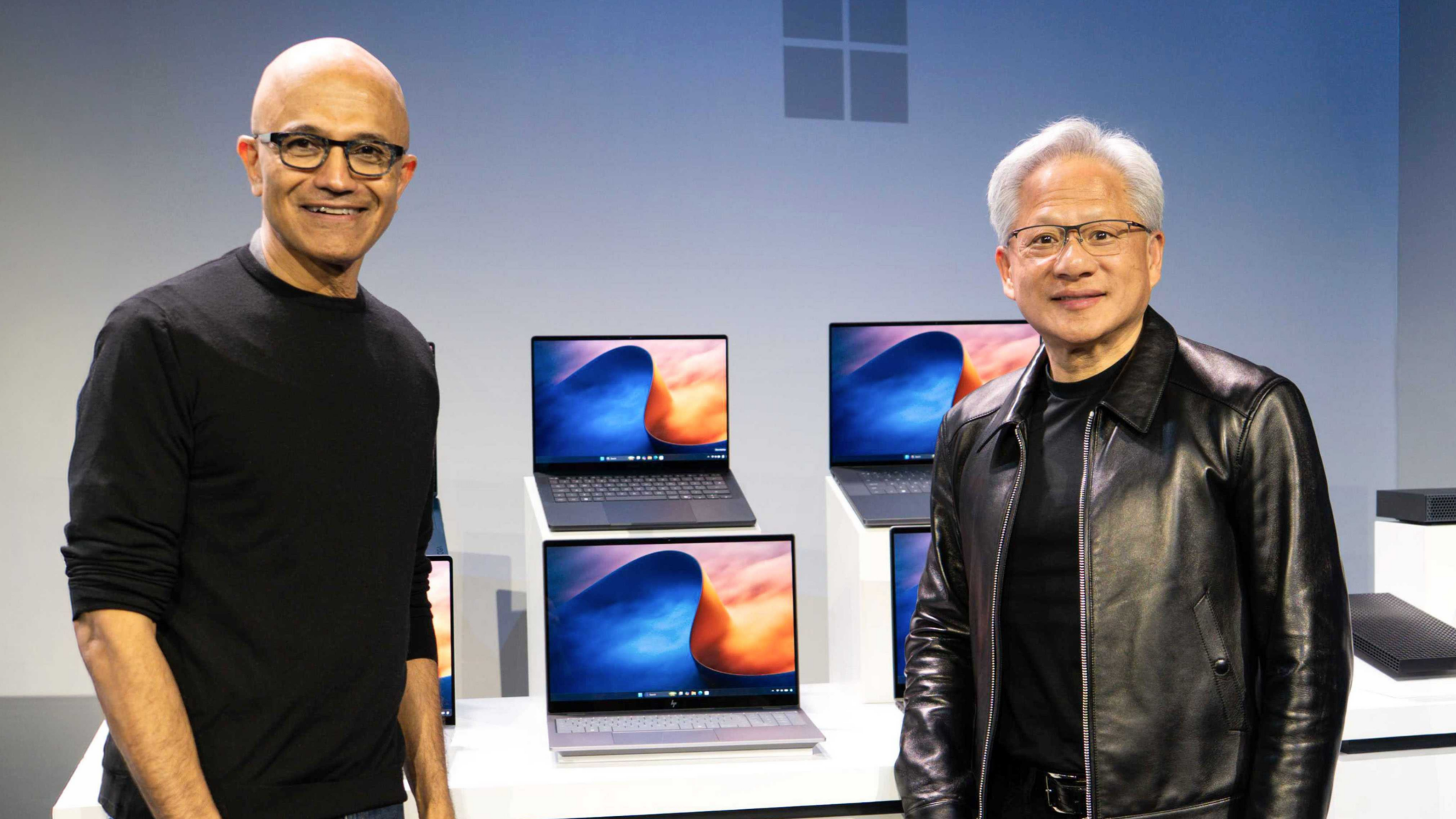
NVIDIA and Microsoft are shaping Windows PCs around software agents that can run locally, stay active in the background and work with the applications people already use. The plan pairs Windows security features with NVIDIA hardware ranging from laptops to a deskside system built for large models.
At a Microsoft event in San Francisco, NVIDIA CEO Jensen Huang and Microsoft CEO Satya Nadella presented the effort as a continuation of a long relationship between Windows and NVIDIA. Huang said Windows helped make GeForce possible, and argued that the personal computer could become a platform for agents acting as personal assistants. Nadella pointed to NVIDIA’s sustained focus on accelerated computing as part of what brought the companies to this moment.
Windows adds infrastructure for background agents
Microsoft announced general availability of Microsoft Execution Containers, or MXC. The operating system infrastructure is designed to let agents run persistently in the background under Windows control. Microsoft says the system gives agents safeguards and tools for observation and governance, alongside Microsoft Security and Agent 365.
That platform layer matters because agents need to do more than answer a prompt: they may need to keep running and interact with local software. Nadella described making the desktop a secure environment for agent execution as a requirement. Huang compared MXC’s potential role in agent development and deployment with the influence Windows and DirectX had on application development. Those are the companies’ assessments; the event did not provide independent security results or deployment figures.
RTX Spark brings NVIDIA’s AI stack to PCs
RTX Spark is NVIDIA’s hardware and software platform for Windows laptops and compact desktops. The systems combine a Blackwell RTX GPU with up to 6,144 cores and a Grace CPU with up to 20 cores, connected at 600 GB/s. NVIDIA lists up to one petaflop of FP4 AI performance and up to 128GB of unified memory.
Microsoft tied the platform to its Surface Laptop Ultra. Windows and Devices executive Pavan Davuluri said the laptop offers up to 128GB of unified memory and up to a petaflop of AI compute, which can accommodate models that exceed the capacity of a traditional machine. Systems are also planned from Acer, ASUS, Dell, HP, Lenovo, MSI and Gigabyte, spanning slim laptops and compact desktops.
NVIDIA says RTX Spark can run models such as Qwen 3.8 Flash Next, described in the source as a 125B model with 51B n-gram. The company says its intelligence matches that of many cloud models, while local use avoids metered cloud inference and sending data to cloud services. The source provides no benchmark methodology or comparative scores for that claim, so it should be read as NVIDIA’s characterization rather than a measured result.
The platform runs CUDA, NVIDIA’s software stack across its hardware. That continuity is aimed at developers who want to move models, tools and workflows between RTX Spark and DGX Station without rewriting them. The systems also target creative work: they include fifth-generation Tensor Cores with NVFP4 support, AV1 acceleration, 4:2:2 video encoding and decoding, DLSS and ray tracing. For gaming, NVIDIA says they can run major games at 1440p above 100 frames per second with DLSS 5, Reflex and G-SYNC.
Laptop preorders opened at the event, with availability stated as Friday, Oct. 16. Compact desktops are expected to go on sale in November. The compact configuration uses the same RTX Spark superchip in a chassis designed for continuous operation, positioning it as a local system for agents that need to stay active.
DGX Station targets large models on Windows
NVIDIA also previewed DGX Station for Windows, a deskside system based on the GB300 Grace Blackwell Ultra Desktop Superchip. NVIDIA lists 748GB of coherent memory and up to 20 petaflops of FP4 AI compute, with capacity intended for models reaching a trillion parameters. Davuluri said the system brings local model capabilities that might otherwise require rented cluster compute to a deskside machine.
The Windows version addresses a workflow split: DGX Station previously ran on Linux, while many enterprise developers rely on Windows for productivity software and existing applications. The new configuration is intended to let teams develop agents, run inference and fine-tune large models alongside their Windows tools and infrastructure. Linux AI toolchains remain available through Windows Subsystem for Linux when needed.
For developers, the practical appeal is access to substantial local memory and compute without leaving the Windows environment. The tradeoffs will depend on system cost, model performance, power and software support; the event did not provide pricing or independent workload measurements. RTX Spark is aimed at portable and compact local AI, while DGX Station offers a much larger memory and compute tier for research and enterprise development. The next test is how these machines perform on real agent workloads, and whether their hardware capacity translates into dependable, useful systems.


