NVIDIA RTX Spark Launch Brings Local AI, Creative Tools and DLSS 5 to PCs
RTX Spark launches with local agent tools, developer frameworks, creative app updates and DLSS 5, alongside a 74B model designed for on-device agents.
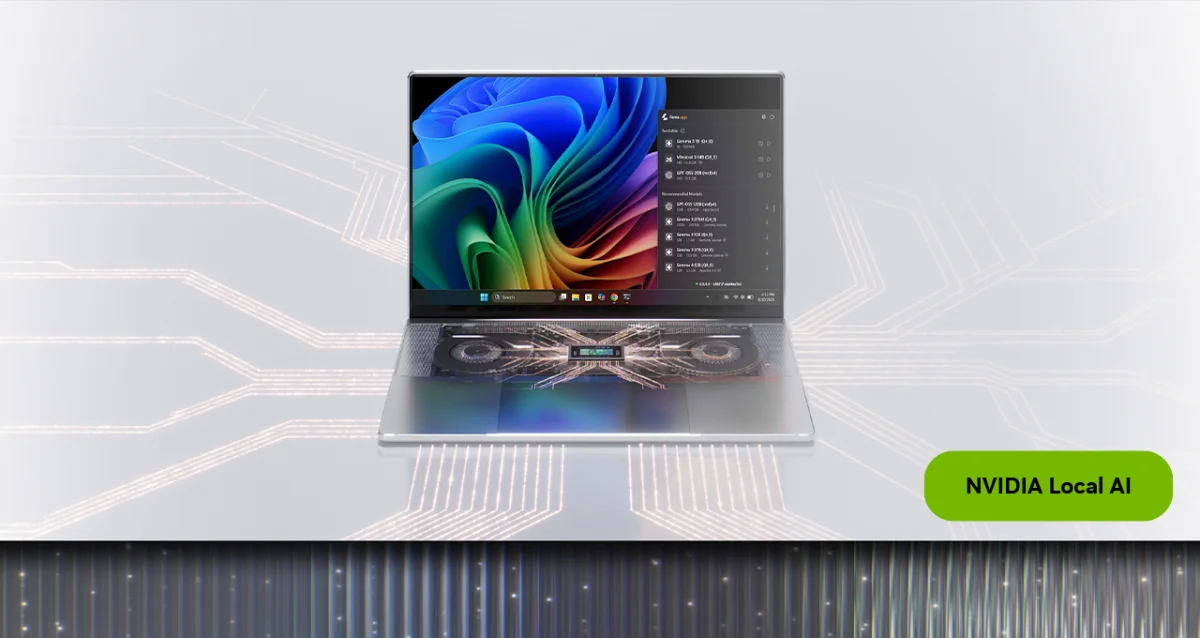
NVIDIA’s RTX Spark launch is built around a broad software stack: local AI agents, creative applications, developer tools and games are all being prepared to run on the new PC platform. NVIDIA says RTX Spark combines gaming and creative workloads with local AI compute, offering up to 128GB of unified memory and 1 petaflop of AI compute. The laptops are scheduled to become available Friday, Oct. 16.
The practical case depends on more than hardware specifications. NVIDIA and its partners are updating applications, models and development libraries to make local inference easier to set up and use. The package includes a 74B-parameter language model compressed to 24GB, new agent security features, Windows on Arm development support, creative app optimizations and a slate of gaming technologies. Some features are available now; others are planned for dates later in October and November.
Local agents get setup and security options
RTX Spark will guide users through installing an agent app at first boot. NVIDIA says GitHub Copilot, Hermes, OpenClaw, Perplexity, Pi and WorkBuddy are adding setup flows that recommend a local model and configuration for the device. The aim is to reduce the steps between installing an agent and running its inference locally.
Security tools are part of that setup. Microsoft Execution Containers (MXC) provide operating system-level isolation, while NVIDIA OpenShell helps agents use MXC and adds credential protection and security monitoring. GitHub Copilot and OpenClaw already support MXC, with Hermes Agent expected to add granular OpenShell controls and MXC by the end of October.
Running locally can reduce reliance on cloud services, but users may still want cloud models for some requests. NVIDIA’s open source Switchyard library is designed to route queries between local and cloud language models. Hermes plans to add Switchyard later in October; Perplexity Computer and GitHub Copilot have their own routing systems. These approaches let users keep some work on-device while reaching cloud models when needed.
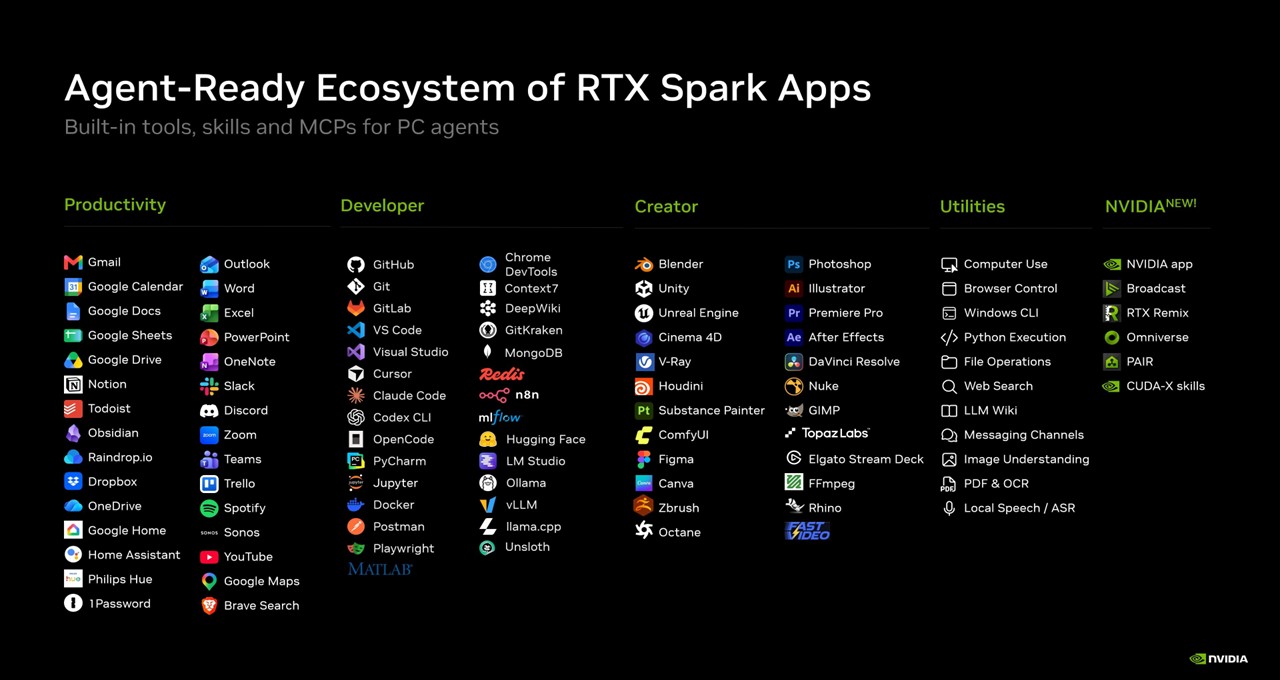
Agents can also connect to Windows applications through model context protocol (MCP) libraries and command line interfaces. NVIDIA is making MCP support available for NVIDIA App, Broadcast, PAIR, Omniverse and RTX Remix, alongside its CUDA-X Skills library. RTX Spark AI playbooks, planned for Oct. 16, will cover setting up an agent, building an AI assistant for workplace tasks, configuring a development system and creating a design assistant.
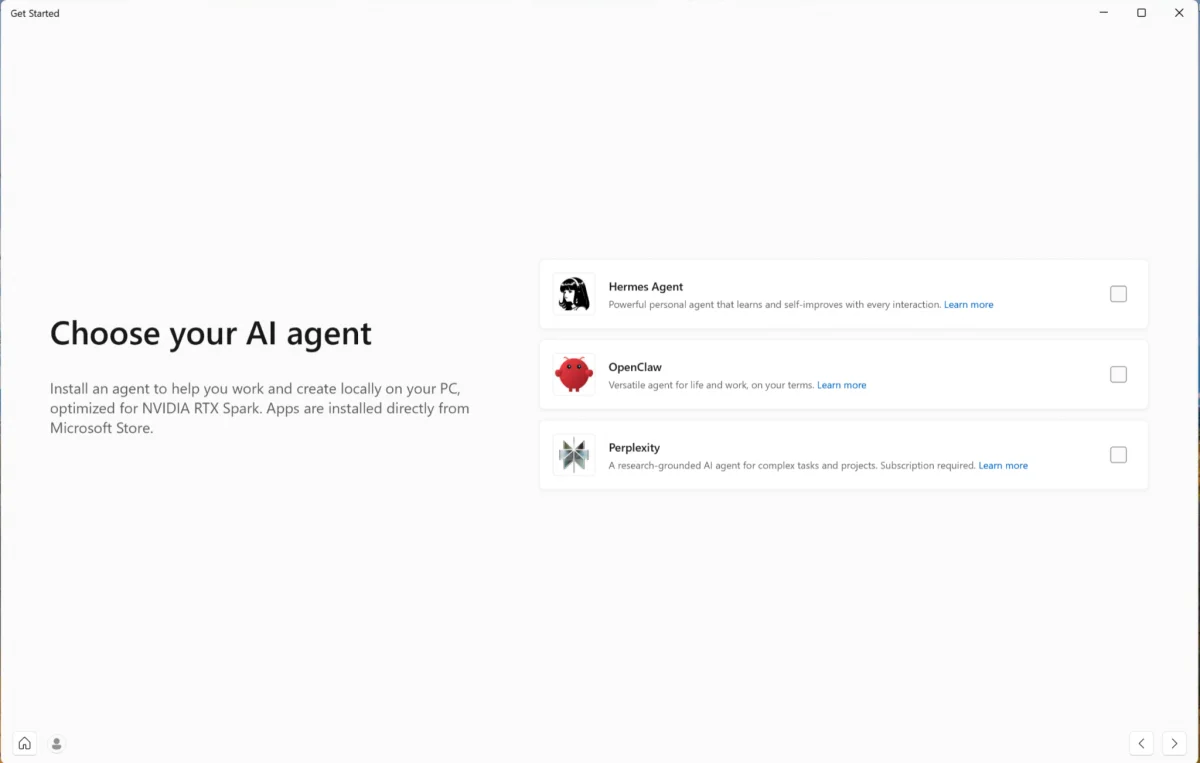
The model announcement anchoring this agent push is Nemotron 3.5 Bolt 74B-A9B 24GB, scheduled for Oct. 15. It has 74 billion parameters, with 9 billion active at a time, using a mixture-of-experts design. NVIDIA says it fits in 24GB through 2-bit quantization and quantization-aware training intended to preserve model quality. The company positions it as faster than popular dense models and more capable than mixture-of-experts models with similar memory requirements.
At launch, the model is expected to run through llama.cpp, vLLM, Ollama, Unsloth and LM Studio, and to be accessible through agents including Hermes and OpenClaw. NVIDIA describes the model as open source, including its training data, weights and recipes, which gives developers material to inspect, fine-tune and adapt for their own agent systems.
Another local compute option is NVIDIA PAIR, a personal AI router that is moving out of beta. The free, open source tool discovers compatible computers on a local network, connects them, installs models and inference engines, and distributes workloads across available machines. Its release adds llama.cpp support, direct model downloads from Hugging Face, configurable inference settings and RTX Spark compatibility. PAIR supports Windows, Linux and macOS. NVIDIA says the project received more than 10 community contributions in the month after its initial release. Developers can contribute through GitHub.
More details on NVIDIA PAIR and its local network features are available from NVIDIA.
Creative applications target GPU-heavy work
NVIDIA says RTX Spark supports more than 130 accelerated creative applications, along with CUDA and RTX technologies such as NVENC and OptiX. Adobe is optimizing Photoshop, Premiere and Substance 3D for the platform, claiming performance improvements of up to 2x across AI tasks, editing, color work and effects. Results will depend on the task and the specific application workflow.
In Photoshop, GPU-accelerated compositing is intended to make complex edits more responsive, with updates to the Remove Tool and effects such as Light Leaks. Premiere optimizations cover playback, rendering, color grading and AI features including Enhance Speech and Object Mask. Substance 3D Painter is set to speed up texture work, including baking high-resolution mesh maps and opening, saving and exporting large projects. Photoshop and Premiere AI optimizations are available in beta; Substance 3D updates are expected later.
NVIDIA Broadcast 2.3, available now, runs natively on RTX Spark and adds Video Super Resolution, Video Frame Generation and Studio Voice profiles. Its Offline File Processor applies effects to prerecorded material, where processing can take longer than real time in exchange for higher quality. A new MCP server and skill also let local agents adjust Broadcast settings and process files through the application. Details and downloads are at NVIDIA Broadcast.
ComfyUI is adding RTX Video Frame Generation and RTX Video HDR nodes, plus the ability to export EXR files. Frame Generation increases frame rates on GeForce RTX 40 Series GPUs and newer, while Video HDR converts standard dynamic range footage to high dynamic range for additional color-grading flexibility. Used with RTX Video Super Resolution, the tools form a workflow for upscaling and enhancing generated video.
NVIDIA’s example combines LTX 2.5 with Frame Generation and HDR to turn a 1080p, 30-frames-per-second SDR clip into a smoother 60-fps HDR video exported as EXR for color grading. That describes a particular workflow, not a universal result for every input clip.
Blender 5.3 is available as a beta with RTX Spark compatibility through Blender’s daily builds. DLSS Ray Reconstruction is planned for November, with the goal of making viewport navigation more interactive by updating rendered scenes in real time. The source describes this feature as coming to Blender 5.3.
Developer support arrives across Windows on Arm
RTX Spark is also intended to consolidate coding, testing and prototyping on one machine. Developers can use a Windows Developer Config that installs common tools, or work through Windows Subsystem for Linux to access packages used in cloud deployment. The strategy responds to workflows in which developers use agents to produce code while relying on separate cloud models and virtual machines for testing.
NVIDIA and Microsoft say several foundational tools are ready for Windows on Arm: the first PyTorch-CUDA build for the platform, a native-by-default Python 3.15 build, and the first native Conda installer, with more than 2,000 Conda packages. NVIDIA also says 97% of the top 15,000 Python wheels are ready, with work continuing on the remainder.
NVIDIA Skills is an open source repository that teaches agents to use CUDA-X tools and libraries. The goal is to let developers build applications accelerated by NVIDIA technologies without needing to know CUDA in advance. The repository is available at GitHub.
GitHub Copilot is adding MXC support and updating its HydraFusion model router to work with local models. That could let developers reduce token use by handling some requests on their own hardware, while retaining access to cloud models. Microsoft is making coding models such as MAI 1.1 Coding Flash available locally and adding llama.cpp as a backend to Windows ML, which broadens model support and enables NVIDIA performance optimizations. Developers can read about GitHub Copilot’s local model and sandbox support, HydraFusion and Microsoft’s local coding model plans. GitHub’s Copilot documentation describes how to get started when RTX Spark launches.
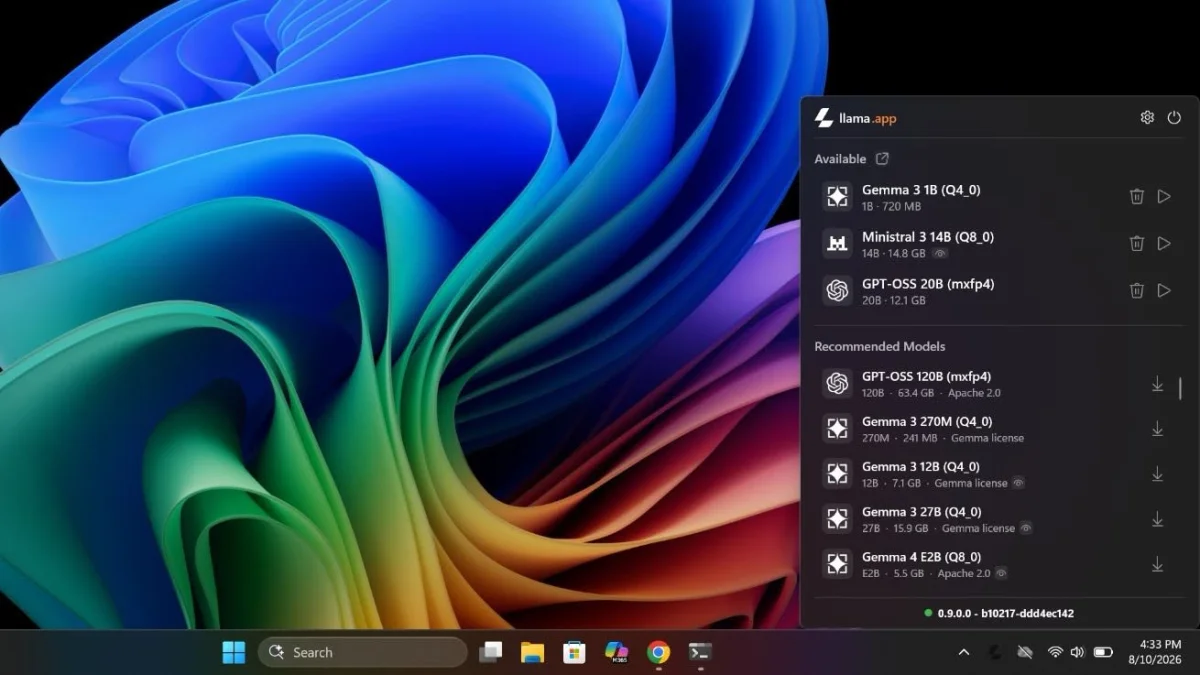
Llama.cpp now supports decision models, which are designed to select an action quickly without extended reasoning loops. NVIDIA says these models can make decisions up to 200 times faster than traditional agents. Llama.cpp and Unsloth support them on RTX Spark and GeForce RTX GPUs. Llama Windows, a new Windows-native companion app, provides a graphical interface for downloading and running models without using the command line. The app is optimized for RTX Spark; more information is available on GitHub and the Hugging Face blog.
Gaming support includes DLSS 5 and local characters
NVIDIA says hundreds of games will be supported when RTX Spark laptops launch Oct. 16, including CONTROL Resonant, Cyberpunk 2077, Fortnite, Gears of War: E-Day, Genshin Impact, Hogwarts Legacy, Honkai: Star Rail, Marvel Rivals, NARAKA: BLADEPOINT, NBA 2K27 and World of Warcraft. NVIDIA says the platform supports its RTX stack, including DLSS, Reflex, Remix, G-SYNC and ray tracing, and that it has worked with developers on anti-cheat support for multiplayer games. Further details are on the RTX Spark gaming page.
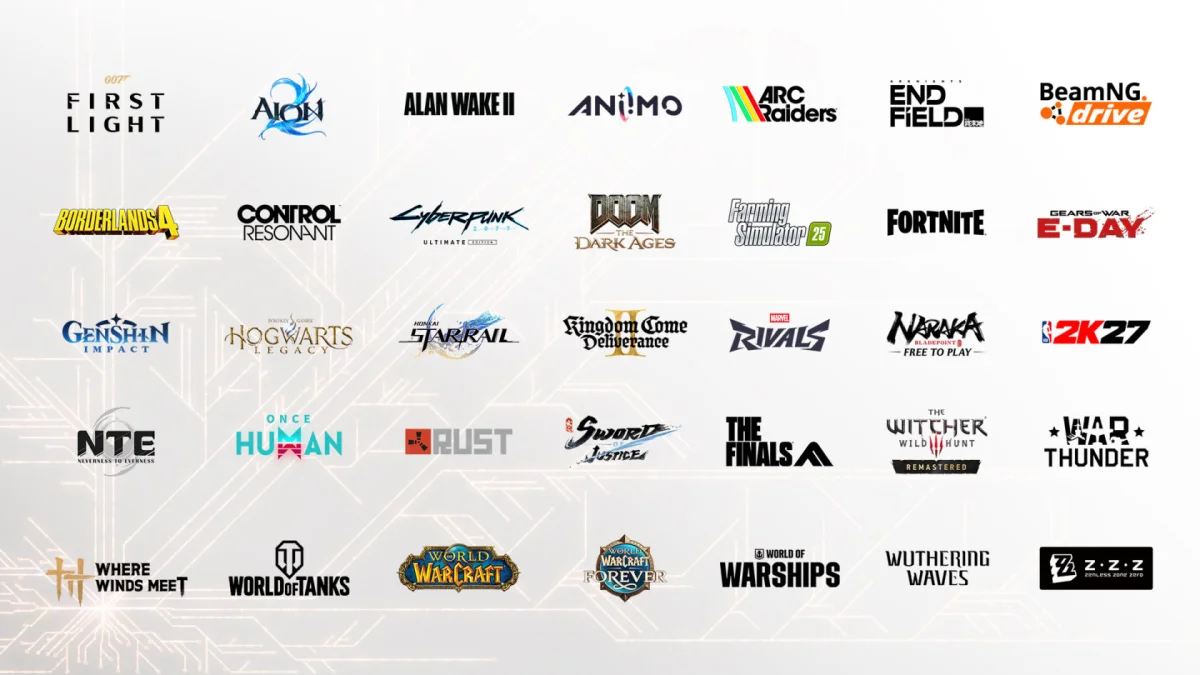
DLSS 5 with 3D-Guided Neural Rendering is scheduled to arrive at launch. NVIDIA says it uses AI to enhance lighting and materials while preserving the visual direction set by game developers. A new model that NVIDIA describes as 2x faster debuts in NBA 2K27 on Oct. 16, where it is expected to increase frame rates by up to 1.4x. The model is planned for Hogwarts Legacy starting Nov. 5 and Where Winds Meet later in November.
RTX Remix will add DLSS 5 support on Oct. 23, giving modders tools to update materials, lighting and shadows in older game environments. NVIDIA points to Fallout 4 RTX, an in-development project by modder Sparkles/Kim2091, as an example. Details are available in the DLSS 5 and RTX Spark overview.
Local models are also being positioned for in-game characters. Nemotron 3.5 Bolt E4B 4GB is the third-generation small language model for NVIDIA ACE, a collection of technologies for building game characters and assistants. NVIDIA says the model combines natural conversation, multi-turn tool use, instruction following and grounding in application state. Its small memory footprint and fast time to first token are intended to leave room for the game and other models. Developers can switch reasoning on or off, and a conversational mode is designed to produce concise, speech-ready responses.
The earlier ACE model appeared in a public beta for PUBG, where players could team up with AI characters. A second-generation model was shown in Aniimo at Gamescom as a basis for voice-responsive creature companions. The new model is scheduled for Oct. 23 in SkyrimNET, a modding platform for The Elder Scrolls V: Skyrim. SkyrimNET gives non-player characters memory, voice and autonomy for unscripted conversations and context-aware quests. Its RTX Spark build supports both local and cloud inference across multiple models and is available through GitHub.
RTX Remix 1.6, also planned for Oct. 23, updates texture-generation workflows for modders. Its ComfyUI Version 2 interface replaces complex REST API node connections with AI tools in a sidebar. Users will be able to generate physically based rendering materials within Remix, process batches of textures and adjust presets without editing a node graph. The change should make it easier to move from testing one texture to handling larger projects.
RTX Spark’s software story spans several areas, but the adoption test will be how these pieces perform together: local models need to fit memory budgets, Windows on Arm tools need to work across real development environments, and agent routing needs to make local and cloud use predictable. The launch brings a wide set of options; practical results will depend on application support and workload-specific performance.
NVIDIA RTX Spark details are available from NVIDIA. The company also offers its Local AI newsletter and updates through X, Instagram, TikTok and Facebook.
See notice regarding software product information.


