iPhone Duo Screen Cracks Put Its Hinge and Repairability Under Scrutiny
Some iPhone Duo inner screens have cracked soon after use. An iFixit teardown points to hinge stress and shows why repairs may be difficult.

Reports of cracked inner screens on some iPhone Duo units have put the foldable’s hinge and repair options in focus. The failures appear to affect a small number of devices, and an iFixit teardown offers a possible mechanical explanation: a support bar in the hinge may press against the display as it folds. That theory hasn’t been confirmed as the cause.
The reports began appearing on Reddit, with some owners describing cracks after very little use. One account says the screen failed during initial setup. Other damage may come from deliberate stress testing, including a video by YouTuber JerryRigEverything, so the reports don’t establish how often ordinary use leads to a failure. WIRED’s review unit remained intact after more than two weeks of daily use. The publication describes the affected share as small, while noting that failures have surfaced quickly for some owners.
Apple says users who encounter inner-display problems should contact AppleCare about a replacement. A company spokesperson told WIRED that Apple was aware of an issue affecting a small number of units. The response gives affected owners a route to service, but doesn’t explain what is failing or whether the cause has been identified.
What the teardown suggests about the hinge
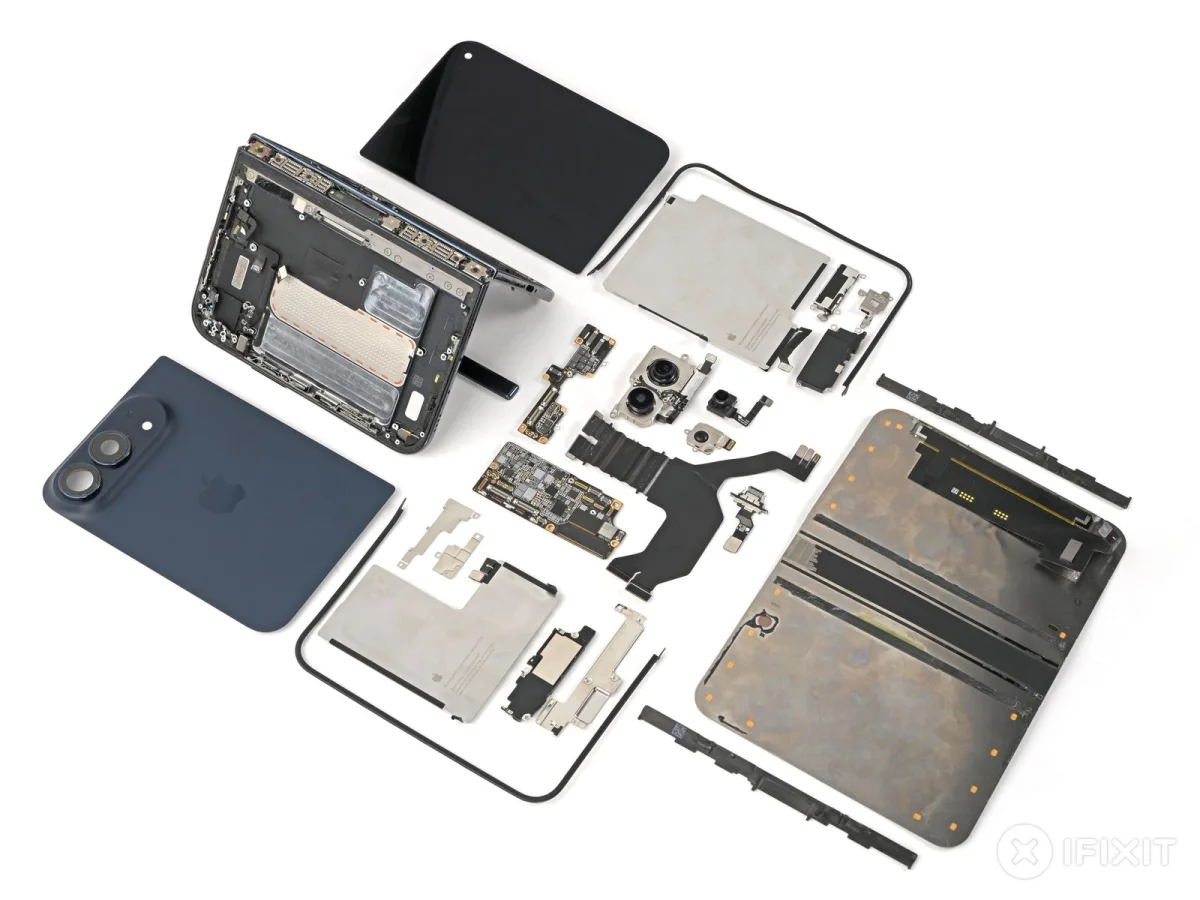
In its teardown and accompanying video, repair company iFixit examined the $1,999 phone’s internal parts and how they come apart. Its stress-test simulation points to the center support bar along the hinge. As the display folds, the bar may fail to move clear of the screen, concentrating pressure near its center. That could help explain the cracks, though iFixit’s proposed mechanism remains a theory rather than a confirmed diagnosis.
A folding display has to bend repeatedly while staying connected to other components, including cables that cross or pass near the hinge. That puts the fold area under particular mechanical demands. Dust adds another challenge: particles can collect around the hinge and may affect how smoothly it moves. The source reports that dust also gathers at familiar openings and edges, and that debris inside the hinge can make the phone sound “crunchy.” These details make the hinge an area to watch in both daily use and future repair work.
Foldable phones have faced related design problems before. Samsung paused sales of its original Galaxy Fold in 2019 and made changes after early device issues, including problems associated with the screen and hinge area. The category has matured since then, and such failures have become less common. Still, a lower failure rate doesn’t make these devices easy to repair: the thin display, moving parts and layered materials can turn a local fault into a demanding repair.
Repairable parts, fragile inner display
iFixit gave the Duo a provisional repairability score of 5 out of 10, the highest rating it has assigned to a foldable phone. The score could change depending on how Apple supplies replacement parts. Some components appear comparatively accessible: the battery and rear panels are straightforward to remove, the outer trim comes off in one piece, and the 5.4-inch front display can be removed without the same difficulty as the inner screen. Brackets and reusable screws hold most components together, which makes reassembly more practical.
The inner display is the harder case. A thin matte nano-texture layer sits above the OLED panel, and careless handling can peel that finish away. Apple tells users not to remove it on its support page. Taking out the full display means warming the adhesive with a heat gun and carefully lifting the panel. The process demands care around the component that appears most vulnerable in the crack reports. Apple offers an inner-screen repair service for $999, a substantial cost beside the phone’s $1,999 price.
That repair cost makes the availability of service information and parts relevant to owners, not just repair shops. Apple has offered a repair manual from the Duo’s launch day, giving people access to instructions that the company hasn’t always made available at release. Its broader move toward repair options began in 2021, though early tools and kits drew criticism for being expensive or less useful than they could be. The Duo’s manual is a concrete step for access to information; it doesn’t, by itself, make the most delicate repair easy or inexpensive.
What owners and repairers should watch
For now, the key uncertainty is whether the hinge support bar explains the early cracks. The reports, the teardown simulation and the apparent concentration of strain point to a plausible place to investigate, but they don’t establish a confirmed cause or show how widespread the fault is. Apple’s advice to contact AppleCare gives affected owners a next step, while iFixit’s findings show why preventing damage to the inner display may matter: removing and replacing it involves heat, adhesive and a fragile surface finish.
iFixit CEO Kyle Wiens described foldables as exceptionally difficult to engineer, citing the demands of material engineering and materials science. The Duo’s 5/10 score suggests that some repair choices can make a foldable more serviceable, even while the central display remains delicate. As more devices are used and repaired, clearer evidence about hinge failures—and the availability and cost of replacement parts—will determine whether that promising score translates into practical repairs.