Bluechip’s SMIDGE Framework Grades Stablecoins on Reserves, Governance and Risk
Bluechip uses six criteria to rate stablecoin safety, with its co-founder explaining why transparency, reserves and risk controls shape the scores.
Stablecoins are designed to keep a steady value, but that promise depends on how each coin is backed and managed. Bluechip, a nonprofit rating agency, aims to make those differences easier to assess. Its SMIDGE framework grades stablecoins across several dimensions, from reserves and management to governance, and offers users a structured view of risks that a coin’s market size alone can’t show.

Bluechip co-founder and chief economist Garett Jones says the project has been in development since summer 2022. The team also includes CEO Benjamin Levit, whose background is in online commerce, and chief ratings analyst Vaidya Pallasena, a chartered accountant known online as Deathereum. Jones is a monetary economist who has written about banking, exchange rate crises and the institutions needed to manage them.
The case for independent ratings rests on a basic problem: a digital token that represents a dollar must maintain parity with the dollar people expect to receive. That challenge has an analogue in banking, where customers expect the money in a checking account to retain the value of paper currency. Blockchain technology changes how a claim is issued and transferred; it doesn’t remove the need to establish what backs that claim or how it can be redeemed.

Six dimensions, with ratings still in development
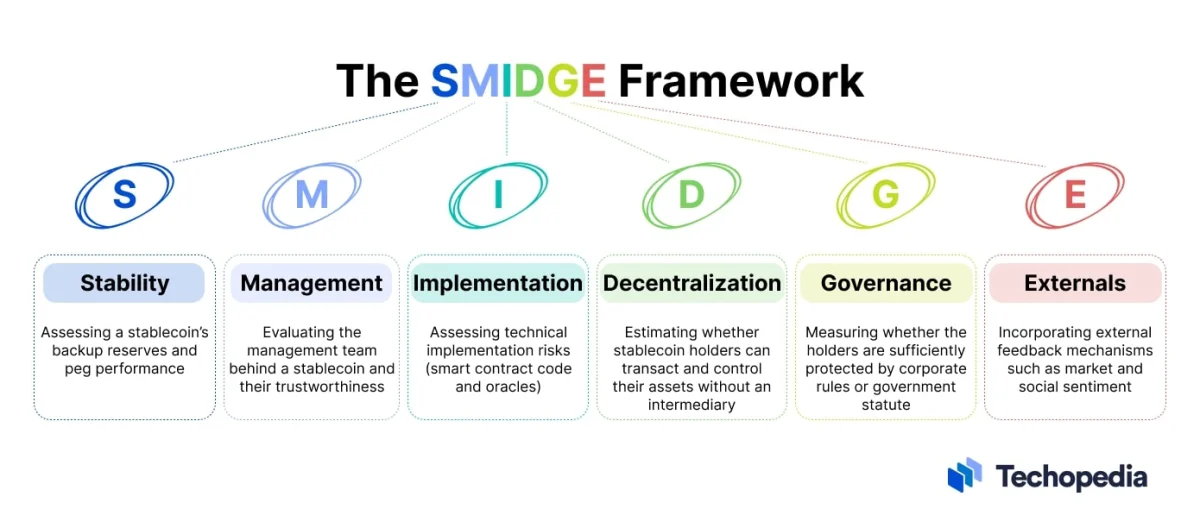
SMIDGE stands for Stability, Management, Implementation, Decentralization, Governance and Externals. Bluechip’s ratings currently cover the framework’s consonants, according to Jones. The categories described in the interview are Stability, Management, Decentralization and Governance.

- Stability considers whether a coin has sufficient backing and how well it has maintained its peg over time.
- Management assesses whether the team responsible for the coin meets Bluechip’s standard for trustworthiness.
- Decentralization applies to on-chain coins and examines whether they provide the privacy protections users may expect from decentralized systems.
- Governance looks at whether holders have adequate protections through corporate rules or applicable statutes.
The framework takes inspiration from CAMELS, a rating system used to assess financial institutions. Jones points to its attention to asset quality, management and liquidity as relevant ideas, while describing SMIDGE as tailored to the specific features of stablecoins. The evaluation spans both the assets behind a coin and the structures that determine how it is run.

That breadth matters because a stable peg can conceal weaknesses. A coin’s record of holding its target value is useful evidence, but it doesn’t answer every question about its reserves, decision-making or protections for holders. SMIDGE aims to put those factors into the same assessment, rather than treating past price stability as a complete measure of safety.

Jones says the framework is open to criticism and to competing rating systems. Bluechip has spoken with supporters and critics, and Jones said he used a talk at Stable Summit in Paris to encourage others to start rating agencies. His view is that stablecoins, like bonds, cars and laptops, can be judged through more than one reasonable methodology. Multiple assessments can help users see where analysts agree and where their methods differ.

Nonprofit status and a fixed method
Bluechip’s nonprofit structure is one part of its effort to build credibility. Jones says its co-founders hold no stablecoin governance tokens, removing a direct financial benefit from particular coins performing well. The organization also receives donations from a range of contributors, both within and outside the stablecoin sector; Jones said that donor base was becoming more diverse.

For Bluechip, the central safeguard is its published framework. Jones argues that a fixed set of criteria makes ratings less dependent on case-by-case judgment calls. A transparent method gives issuers and users a way to understand how an assessment was reached and what areas could affect a score.

Bluechip doesn’t have the power to require issuers to change their practices, and Jones says it doesn’t seek that power. The agency’s theory is that a weak rating could give issuers a reason to improve. Some coin issuers contacted the team before its public launch to ask how they might raise their ratings. Bluechip says it is willing to explain why certain operating choices appear safer or more transparent than others.

That influence depends on whether users and issuers trust the process. A rating can make risks more legible, but it can’t guarantee that reserves are sufficient or that a coin will remain stable in the future. Its usefulness therefore rests on the quality of the evidence, the consistency of the scoring and the willingness to revise an assessment when the facts change.

Why Tether and Binance USD received different grades
The ratings can diverge from impressions based on a coin’s size or public status. Bluechip gave Tether’s USDT a D, while Binance USD (BUSD) received an A, despite BUSD having been halted by the New York State Department of Financial Services. Jones says the scores reflect the dimensions in SMIDGE, including stability and governance, rather than simply the scale of a coin or decisions made by other organizations.

Bluechip’s concerns about USDT include transparency and the quality of its reserves relative to some competitors. Its assessment says USDT is less transparent and has inferior reserves, and suggests that a complete financial audit by an independent auditor could help improve its grade. The interview doesn’t provide a full breakdown of each coin’s scores, so the examples illustrate Bluechip’s stated reasoning rather than allowing readers to reproduce the ratings from the available details.

Jones says Bluechip will publish its own conclusion when it differs from an assessment by a public body. He argues that independent views should be visible alongside one another, rather than having a rating agency simply repeat another institution’s judgment. For users, that makes it important to examine the reasoning behind each grade and understand which parts of a coin’s design the framework weighs most heavily.

A high rating indicates that a stablecoin meets most of Bluechip’s criteria. A D or F, Jones says, should at least be read as a strong caution. He personally would feel more comfortable using a coin with a high Bluechip grade, but he frames the choice as a matter of individual risk tolerance. His analogy is vehicle safety: people may choose different options even when their relative risks differ.

The qualities he associates with a safer stablecoin are transparent governance, strong backing assets and effective risk management. Those qualities don’t eliminate uncertainty. Jones argues that stablecoin reliability should be judged over decades, not just months or years, and invokes economist Rudiger Dornbusch’s observation about exchange rate crises: “The crisis takes a much longer time coming than you think, and then it happens much faster than you would have thought.” The quotation captures a practical limitation of short track records: a coin can appear steady until conditions change quickly.
Stablecoins as a payment complement
Jones sees stablecoins continuing to grow as part of payment systems, while remaining a complement to national currencies rather than replacing them. He expects their use to expand in middle and upper-middle-income economies over the next few years. As an indicator of broader commercial interest, he points to PayPal’s adoption of stablecoins in its payments system.
The interview cites stablecoin transaction volume of $7.4 trillion in 2022, even after the collapse of TerraUSD. That figure signals substantial activity, but transaction volume by itself doesn’t establish that every coin is safe or suited to every user. Bluechip’s approach is to add a structured assessment of backing, governance and operational risks to the information people consider when choosing a coin. For users and developers, the practical takeaway is to look beyond the peg and market presence: the quality of reserves, disclosure and risk management shapes how much confidence a stablecoin can reasonably support.


