Acres of Ice Automates Himalayan Ice Reservoirs to Store More Meltwater
Acres of Ice’s automated reservoirs in Ladakh stored over 4 million liters, while reducing maintenance visits and testing year round ice retention.

Acres of Ice is using sensors, valves and purpose built fountains to automate the construction of ice reservoirs in Ladakh. At its Igoo installation, the system stored more than 4 million liters of water and reduced maintenance visits from every other day to twice a month, according to co founder Suryanarayanan Balasubramanian. The results suggest automation can make a traditional water storage technique easier to manage in remote mountain villages, though the team is still testing how long the stored ice lasts.

The stakes are regional. Himalayan glaciers supply water for food production, energy and daily use across a region that the source says is home to two billion people and spans eight Asian countries. It warns that the glaciers could lose 80% of their volume if no action is taken. Acres of Ice is developing artificial ice reservoirs as a local adaptation tool for communities that rely on glacial meltwater, rather than claiming that its installations can reverse climate change.

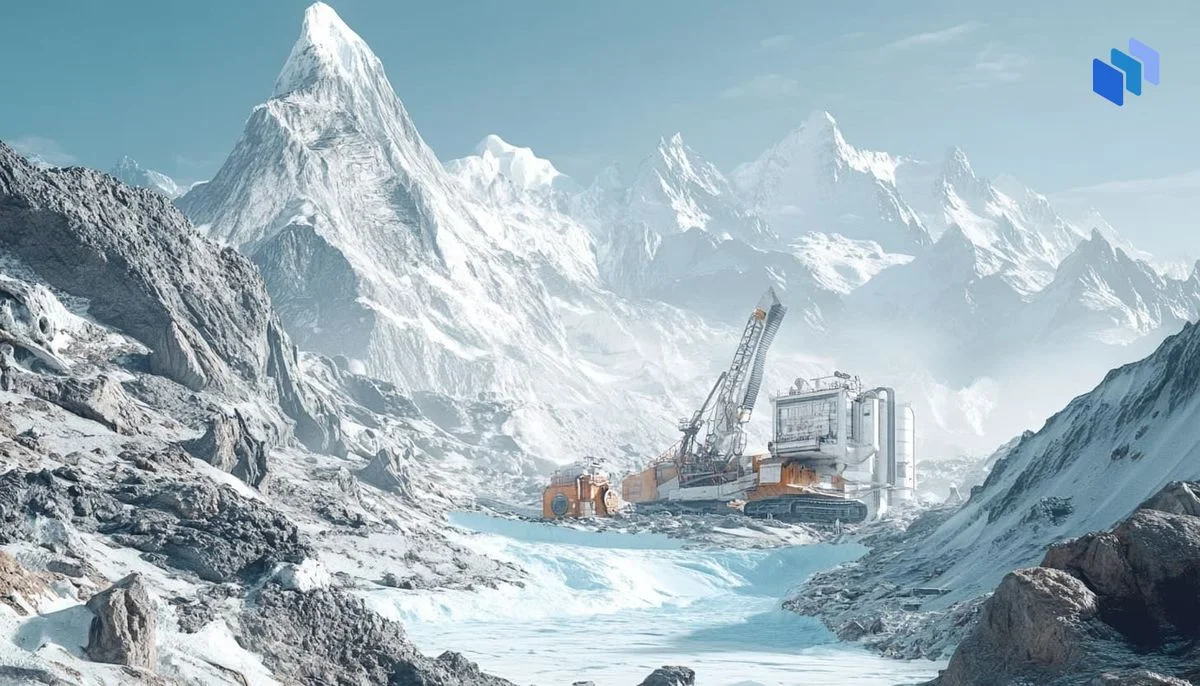
Automation built around weather conditions
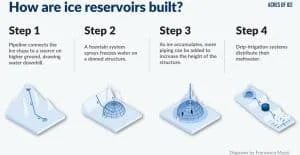
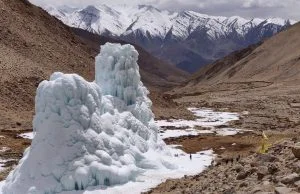
The system draws water from a spring or glacial stream through a pipeline. Mechanized valves direct the flow either toward a fountain or into a drain mode. When temperature and pressure conditions are suitable for ice formation, the controller opens the route to the fountain, which sprays water into the air. The droplets freeze and accumulate as an ice structure.

When conditions are unsuitable, the system switches modes: water is pushed back toward the stream and air can pass through the pipeline. That arrangement is intended to reduce the chance of water freezing inside the pipes. Sensors feed information to a printed circuit board (PCB), which selects the operating mode. The board also supports an app for collecting system data and making it accessible to villagers.

The fountain design matters as much as the controls. Acres of Ice uses 3D printed fountains designed around the relationships among droplet size, spray trajectory and weather. Those factors affect how much water freezes and where ice forms. The approach is meant to take advantage of suitable weather windows while limiting unnecessary water flow when conditions will not produce useful ice.

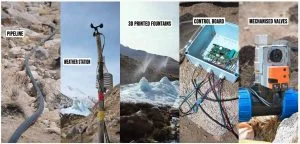
Balasubramanian describes the system as maintenance free when weather and pressure conditions are right. In practice, the project still depends on preparation, local monitoring and troubleshooting. The system automates decisions about when to spray and drain; it does not remove the need to check equipment or keep it working through winter.

Designed for remote, cold installations
Installations in rugged mountain terrain are difficult to reach, especially during winter. Acres of Ice says half its team contributes remotely. Staff involved in installation and repair try to test equipment before winter begins, while the project uses higher quality components and protective insulation to help equipment function in the cold.

The team has also formed a village water management committee to visit installations weekly and report problems. That local role is part of the operating design. Balasubramanian says regular visits from the company are impractical, and some locations lack internet access for remote monitoring. A connected dashboard may help where service is available, but local checks remain necessary where it is not.

Igoo results and the next test
In Igoo, a town in Ladakh, the automated ice reservoir (AIR) increased reported water storage to more than 4 million liters. Balasubramanian says the installation achieved more than 80% water use efficiency, compared with around 20% for traditional reservoirs, which he says typically hold about 1 million liters. The project also reports twice the water storage, fewer maintenance visits and avoidance of pipeline freezing events.

The source describes two different earlier visit schedules: maintenance fell from daily to monthly, while monitoring fell from every other day to twice a month. These figures refer to different tasks and shouldn’t be read as the same measure. Together, they point to less frequent on site work, although the reported results come from the Igoo project and the article does not provide an independent evaluation or a detailed method for calculating efficiency.

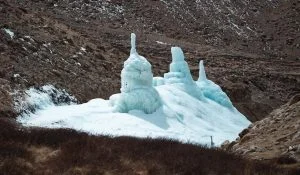
The project revived local ice reservoir construction during winter 2023–2024. Acres of Ice says the structures can grow when the fountain operates during favorable weather, potentially adding to stored ice over successive winters. The team kept the Igoo system running through spring and summer to test whether the reservoir could preserve ice until the next winter. That trial addresses a key practical question: how much of the stored water remains available through warmer seasons?

Local skills are part of the system
Acres of Ice trains village water management committees to maintain the equipment and use other water practices, including drip irrigation. The aim is for committees to help keep water storage and distribution devices functional over time. This makes community involvement more than an outreach component: it helps cover the monitoring gaps created by distance, difficult access and limited connectivity.

Balasubramanian argues that community adaptation does not always require a large budget. He says households in Ladakh, each earning less than $40,000 annually, have historically pooled contributions of up to $4,000 for water management and climate resilience work. The source offers this as an example of local funding capacity, not a cost estimate for an AIR installation. The current scale of adaptation needs is larger, he says, but modest contributions can still support mountain communities.

The team combines experience in ice reservoir technology and water management. Balasubramanian began as a volunteer with the Ice Stupa Project, led by Sonam Wangchuk, in 2015, and managed the initiative through 2019. He later completed a doctorate at the University of Fribourg, studying the weather conditions and design choices relevant to artificial glaciers from 2019 to 2023. Afterward, he started Acres of Ice to put the resulting software and hardware into field use.

Co founder Basit Afzal brings a decade of experience with water management methods such as micro irrigation. The founders have worked with local Ladakh organizations and, according to the source, helped more than 500 farmers use automated ice reservoir technology. Mechanical engineers design the fountains, electronic engineers build the PCBs, and a field manager and villagers support maintenance.
From a local installation to reusable kits
Acres of Ice estimates that around 14 million people across more than 14,000 villages in 16 countries in the Hindu Kush Himalayas and the Andes are affected by glacier related water challenges. The estimate uses population datasets for people living above 3,500 meters in glacial regions. Balasubramanian says the actual number is higher because the method excludes some glacier regions where population centers sit at lower elevations, including the Alps.
The company is designing automation kits for mountain villages facing increasing aridity and dependent on glacial meltwater for irrigation. A kit is expected to include a custom controller, valves, fountains and a manual for choosing a pipeline layout and water source. Users would download the software from the company’s website and assemble the components using the manual. Where internet access exists, a web dashboard would let users observe and control the system.
The first kit trials were planned for ten Ladakh villages during the winter described in the source, with deployments in some villages in Peru and Nepal within a year. The company also says it wants to develop additional water management methods, including artificial snow, fleece covers and drip irrigation. Its broader proposal includes using the kits to defuse glacial lakes and build and maintain artificial glaciers; the source provides no further technical details about that work.
For now, Igoo offers a promising field result, with substantial reported storage and fewer monitoring trips. The next useful evidence will be whether the ice persists through warmer months, whether the reported efficiency can be reproduced at other sites, and how well local teams can keep installations running under different weather and connectivity conditions.
Further information
Learn more about Acres of Ice, the Ice Stupa Project, and Acres of Ice’s account of its first year. Balasubramanian’s professional profile provides further background.


